Coronation, Lombard style

At time I started writing this post, the anglophone press was running wall-to-wall stories in anticipation of the coronation of Charles III of the United Kingdom. There’s tons to read about the British regalia, the rituals, the religious ceremony, and cultural symbolism. Which led me to think about the all-important ritual of king-making in the Lombard era. And for once, we know (or can surmise) a fair bit about it!

Throughout this post, I rely heavily on the work of Stefano Gasparri, particularly his book La Cultura Tradizionale dei Longobardi. Struttura Tribale e resistenze pagane, as well as some of his more recent articles, especially “La regalità longobarda. Dall’età delle migrazioni alla conquista carolingia,” in Alto Medioevo Mediterraneo. I highly recommend Gasparri’s work to those interested in Lombard history and culture. Particularly in La Cultura Tradizionale dei Longobardi, he combines academic rigor with an almost intuitive understanding of the Lombard sources.

The first thing to note is that the Lombards didn’t have a coronation…because they didn’t have a crown–at least not in the period I’m concerned with.
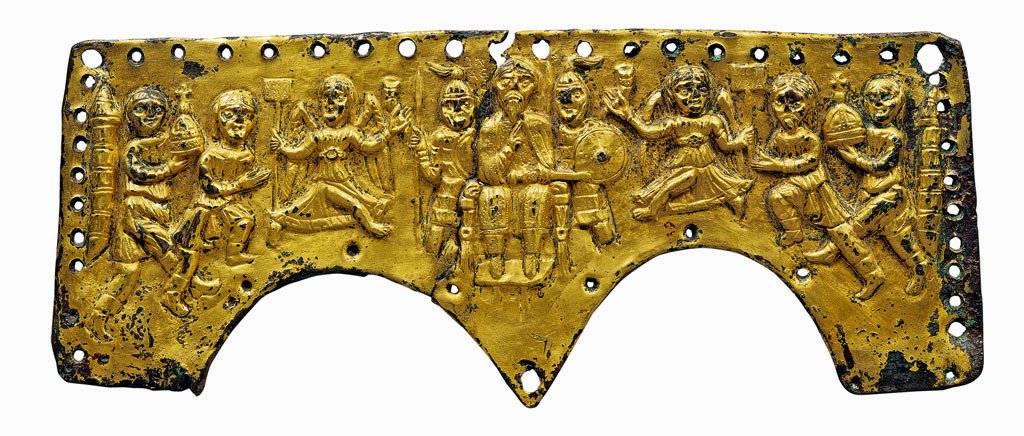
The so-called “Helm of Agilulf” (also known as the Lamina di Valdinievole). It is believed to depict the Lombard king Agilulf (center), flanked by Lombard warriors as he’s presented with offerings. It’s a typically Roman triumphal scene with interesting Lombard elements. For example, the figures of “winged victory” hold drinking horns. Note that Agilulf himself is not wearing a crown or diadem. There is, likewise, a “crown” associated with Agilulf’s queen, Theodelinda, but there’s some debate over whether it was actually hers and, if so, whether it was intended to be worn or offered to a house of worship as a so-called “votive crown.”
Continue reading

A View for the Ages? Part 1

Therefore, when king Alboin with his whole army and a multitude of people of all kinds had come to the limits of Italy, he ascended a mountain which stands forth in those places, and from there as far as he could see, he gazed upon a portion of Italy. Therefore this mountain it is said, was called from that time on “King’s Mountain.” They say wild oxen graze upon it, and no wonder, since at this point it touches Pannonia, which is productive of those animals….

Paul the Deacon, History of the Lombards, Book 2, ch. 8 (trans. William Dudley Foulke, 1907, ed. Edward Peters 1974)

In this short passage, Paul the Deacon describes the migration of the Lombards into Italy. It seems straightforward enough. We know the journey’s starting point: Pannonia. We know Alboin established the first Italian duchy at Forum Iulii (modern Cividale del Friuli). We have the picturesque detail of the oxen-dotted “King’s mountain.” How difficult could it be to deduce a path that connects these points?

But as ever, nothing is quite as simple as it seems.

Continue reading

What is a “fara”?

This year, Alboin, King of the Longobards, leaving and burning all of Pannonia, his fatherland, with all his army, with wives and all his people occupied Italy in “fara”; and there some were killed by illness, some by hunger, and others by the sword.

Marius Aventicensis,Chronicon, 569.1 (580)

Writing circa 580, the chronicler Marius Aventicensis recorded that the Lombards arrived in Italy in 569. This is one of the earliest attestations of the Lombard migration and a great example of how scant and tantalizing the sources from this period can be!

Marius Aventicensis says that the Lombards undertook their migration “in fara”–a term which he apparently presumed his audience would understand. In decades past, the word has been the topic of sometimes strenuous debate among historians and philologists. More recently, a groundbreaking paleogenetic investigation has shed new light on this controversial subject, and it is this data that informs my own answer to the perennial question: what exactly was a fara?

Continue reading

Thurisind or Thaurisinþs?

The matter of names has proven surprisingly tricky. The first issue is that there’s very little uniformity in the historical record or in the literature as to most of the names in question. For example, Rosamund’s grandfather is variously referred to as Thurisind, Turisind, Torisind, and Thorisind. These are all, most likely, approximations of his actual name, which may have included the components thauris (which probably meant “daring”) and sinþs (“path”) or sinþa (“traveler”). Likewise, Alboin’s actual name was probably something like Albwin–meaning “elf friend.”

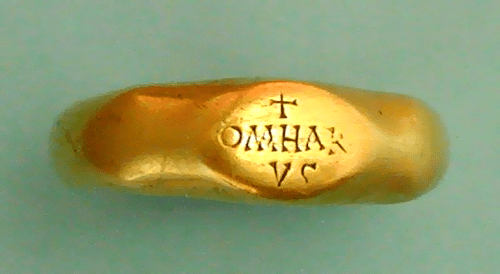
This famous ring is part of the Apahida Treasure, held by the National Museum of Romanian History. The inscription names its presumed owner, Omharus, whose name has been otherwise lost to history. He’s speculated to have been a 5th century Gepidic king who received this ring and other costly treasures as a Roman federate. We don’t know what his name would have been in his native tongue, but it probably incorporated the element harjis (“army”).

All this begs the question: is it a problem if a character has come down to us with a distorted name?

Continue reading

Women’s Traces, Part 3: Living Gifts

I had to invent a mother for Rosamund (whose own existence is up for debate in certain quarters, an interesting topic for another day). But what of Alboin’s maternal line? He, at least, is a historical figure, so he must have had a mother.

There are two theories as to her identity. The first–and most prevalent–is that she was a princess, the daughter of the last independent king of the Thuringians. This would make sense. Both Alboin and his father seem to have had some sort of of Thuringian connection.

So far, so simple. But as ever, when you pull on random a thread from this period, a whole host of fascinating stories tumble into view.

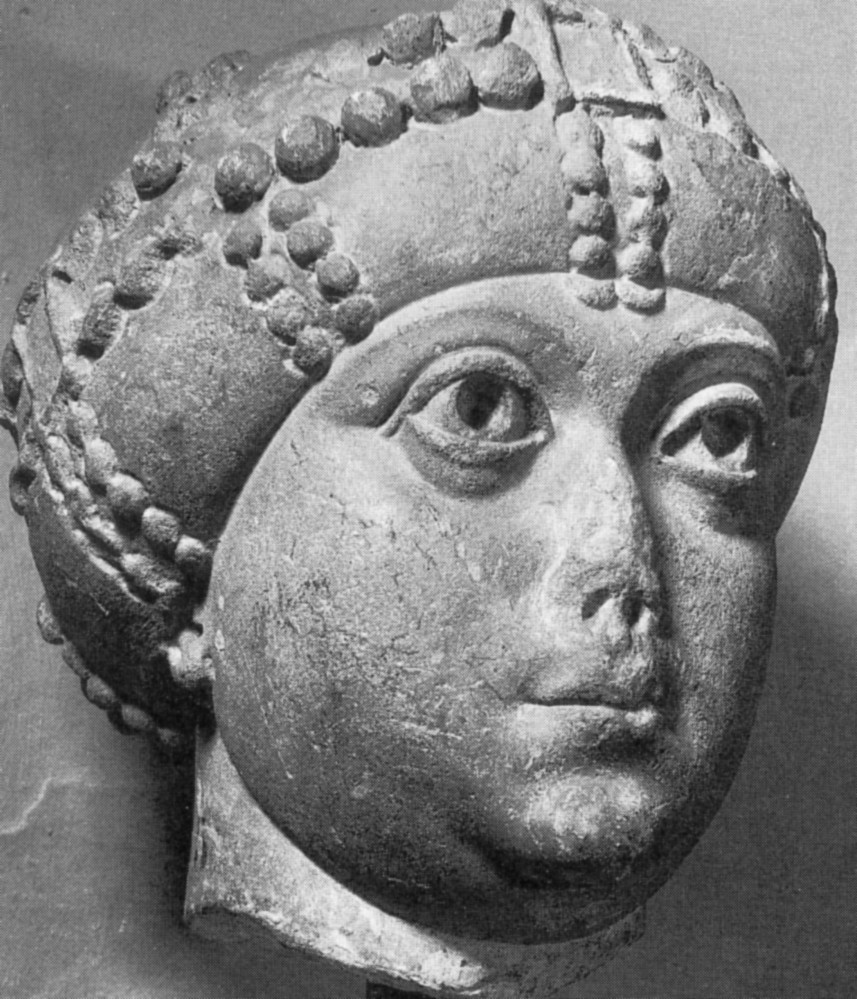
This may be the face of one of her female relatives….Portrait bust of Amalasuintha from the Capitoline Museums, Rome.
Continue reading

This Means War

The Gepid kingdom ultimately succumbed to an alliance between the Lombards and the Avars. The Avars were relative newcomers on the eastern European scene. Their origins have long been shrouded in mystery, but the prevailing theory proposes that they were refugees from the Rouran Empire of the Mongolian steppe, which had been overthrown by the Göktürks. For over a thousand years, their true origins were a mystery waiting to be solved.

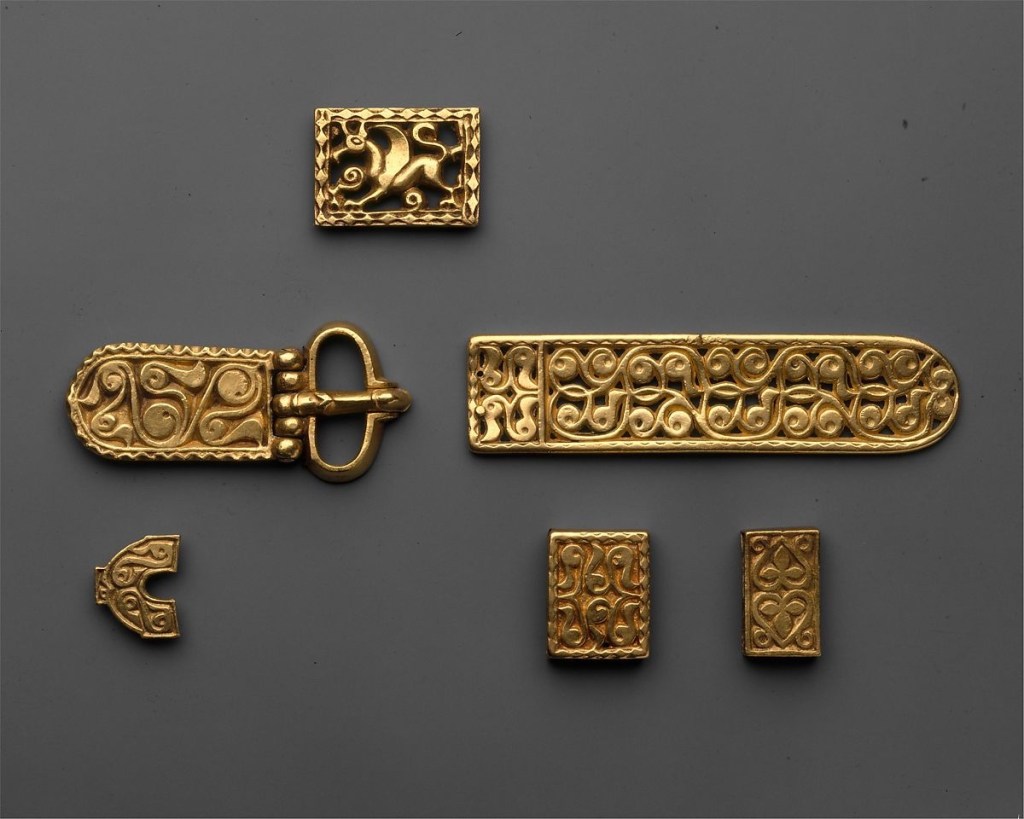
8th century Avar belt fittings, including a belt mount with the figure of a winged horse or griffin. Image via the Met Museum.
Continue reading

Women’s traces, Part 1: Alboin’s Sister

Widsið maðolade, wordhord onleac,
se þe monna mæst mægþa ofer eorþan,
folca geondferde; oft he on flette geþah
mynelicne maþþum. Him from Myrgingum
æþele onwocon. He mid Ealhhilde,
fælre freoþuwebban, forman siþe
Hreðcyninges ham gesohte
eastan of Ongle, Eormanrices,
wraþes wærlogan. Ongon þa worn sprecan
Widsith spoke, unlocked his word-hoard,
he who had traveled most of all men
through tribes and nations across the earth.
Often he had gained great treasure in hall.
He belonged by birth to the Myrging tribe.
Along with Ealhild, the kind peace-weaver,
for the first time, east of the Angle,
he sought the home of Eormanric,
king of the Ostrogoths, hostile to traitors.
He began then to speak at length:
….
Swylce ic wæs on Eatule mid ælfwine,
se hæfde moncynnes, mine gefræge,
leohteste hond lofes to wyrcenne,
heortan unhneaweste hringa gedales, beorhtra beaga, bearn Eadwines.


I was in Italy with Aelfwine too:
of all men he had, as I have heard, the readiest hand to do brave deeds,
the most generous heart in giving out rings
and shining torcs, Eadwine’s son.
     
….  
Ond me þa Ealhhild oþerne forgeaf,
dryhtcwen duguþe, dohtor Eadwines.
Hyre lof lengde geond londa fela,
þonne ic be songe secgan sceolde
hwær ic under swegle selast wisse
goldhrodene cwen giefe bryttian.  

And then Ealhhild, Eadwine’s daughter,
noble queen of the household, gave me another;
her fame extended through many lands
when I used my song to spread the word
of where under the heavens I knew a queen,
adorned with gold, most generous of all.
Widsith, ln. 1-9, 71-75, & 97-102 (Transl. soton.ac.uk/~enm/widsith.htm

The preferred histriographic term for Rosamund’s era is “late antique” or “early medieval.” The old descriptor–“the Dark Ages”–with its ominous insinuation of ignorance, brutality, and decline, has fallen out of favor. And yet, this term persists in the popular imagination.

But if the 6th century of Rosamund and Alboin is dark, that is mostly down to our ignorance, not theirs. Very few primary sources from the early middle ages survive. There are many things we simply do not–and cannot–know . But this profound obscurity makes the sources we do have all the more precious and intriguing.

Continue reading

The cup(s) in question–Part 3

The traditional version of Rosamund’s story is quite straightforward: the proud princess, the tragic fall, revenge, betrayal, death. Although it makes for an exciting story, it all strikes me as a little too neat.

I believe there is another story hidden between the lines of the legend, one that sheds light on the politics and culture of Rosamund’s time. Obviously, this is deeply speculative on my part. But it’s also the aspect of Rosamund’s tale that I find most intriguing. Songs and poems and plays have presented the “Tragedy of Alboin and Rosamund.” I want a glimpse of the gritty, foreign reality lurking behind the legend.

This requires analysis, not only of Rosamund’s experience, but that of her contemporaries. I believe that close examination can reveal elements of their reality that would otherwise remain obscure.

Continue reading

The Grubenhaus of Babel

What language did the Gepids speak? They left no written traces that would provide an answer to this simple question. It is possible they spoke a Gothic dialect, but if so, how similar was their spoken language to the what we know of Gothic based on limited written survivals?

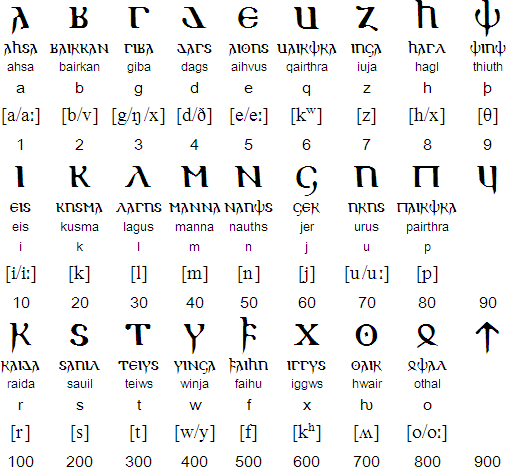
The Gothic alphabet, via omniglot.com

Most of what we know about the Gothic language comes from a few fragments of the Gothic-language Bible, which was first translated under the supervision of a bishop named Ulfilas. (Incidentally, most of these these precious codices are 6th century copies of older manuscripts that have not survived.) Ulfilas (Wulfila in Gothic) was the son of Christian Greeks captured by Goths. He was, thus, raised with a foot in two worlds. He eventually became a priest and a missionary among the Goths, converting many of them to Christianity in the 4th century. As part of his work, Ulfilas decided to translate the Greek bible into Gothic, but first, he needed to devise a Gothic alphabet. His letters seem to draw on Greek, Latin, and Runic influences.

Continue reading

When a crazy idea is too good to resist

Sometime around the year 600, a Gepid mercenary committed murder . His victim was a bodyguard of the Emperor Maurice who had been taking part in an impromptu deer hunt. When the bodyguard became separated from the other hunters, the Gepid fell upon him and threw his body into a nearby ravine. The motive: greed. From his victim, the Gepid took a precious golden belt.

From the collection of the Metropolitan Museum: “This incomplete, massive gold girdle composed of a series of solidi (gold coins) and medallions may have been worn as an insignia of office. The four medallions depicting the emperor Maurice Tiberius (r. 582–602) probably were minted for him to present as gifts to high officials and nobles when he assumed the office of consul in 583.”
Continue reading