At time I started writing this post, the anglophone press was running wall-to-wall stories in anticipation of the coronation of Charles III of the United Kingdom. There’s tons to read about the British regalia, the rituals, the religious ceremony, and cultural symbolism. Which led me to think about the all-important ritual of king-making in the Lombard era. And for once, we know (or can surmise) a fair bit about it!
Throughout this post, I rely heavily on the work of Stefano Gasparri, particularly his book La Cultura Tradizionale dei Longobardi. Struttura Tribale e resistenze pagane, as well as some of his more recent articles, especially “La regalità longobarda. Dall’età delle migrazioni alla conquista carolingia,” in Alto Medioevo Mediterraneo. I highly recommend Gasparri’s work to those interested in Lombard history and culture. Particularly in La Cultura Tradizionale dei Longobardi, he combines academic rigor with an almost intuitive understanding of the Lombard sources.
The first thing to note is that the Lombards didn’t have a coronation…because they didn’t have a crown–at least not in the period I’m concerned with.
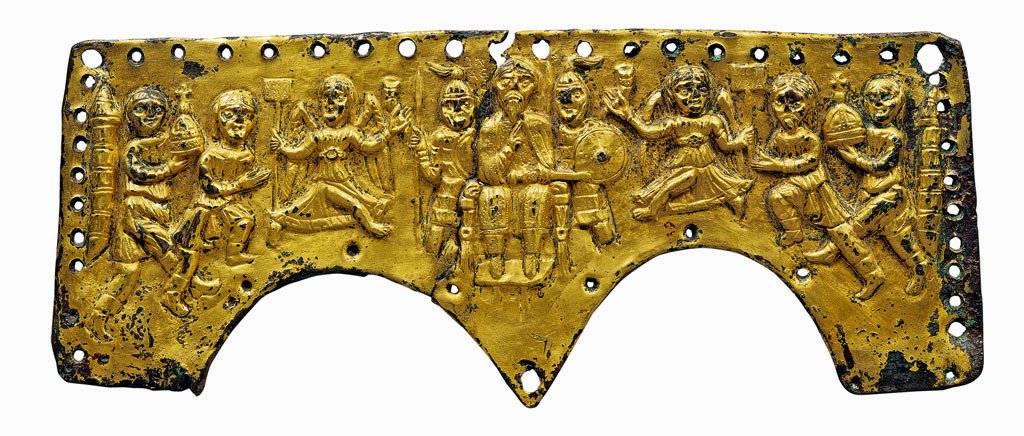
The touchstone image of early Lombard regality is the so-called “Helm of Agilulf,” currently housed in the Bargello in Florence. It is the ornamental plate from the the front of a lamellar helmet (you can check out a really cool imagining of Agilulf (~555-616) wearing the helm here, by digital artist Joan Francesc Oliveras.)
This helm is an important object for a number of reasons. For one, in the decoration we see a visual confirmation of Paul the Deacon’s description of the traditional Lombard hairstyle in the late 6th century–bearded, with hair parted in the center and worn long around the face (to this, Paul added the detail that it was cropped in back–sort of a reverse mullet). We also have a good representation of Lombard warriors, their arms, and attire, in the two guards flanking the king. They carry spears and round shields, and wear lamellar helms with matching armor.
Interestingly, the central royal figure–presumably Agilulf–wears neither helm nor crown, though he does have his hand on his sword. He’s seated on an ornamented throne of some kind, receiving gifts and offerings, flanked by angels of victory. Already, in this early stage of Italian settlement, Christian/Roman iconography had become a major marker of political power, but “traditional” Lombard elements are still present, specifically the spearmen.
Up to the 5th and 6th centuries and almost certainly beyond, the primary symbol of authority among the Lombards was the royal lance or staff. Paul the Deacon records the first Lombard king as Agilmund of the Guging family. Agilmund was a semi-legendary figure, and his family name has mythic overtones. The Gugings took their name from the spear of the god Godan, which was called gugin among the Lombards. A related name appears later among the Norse as guginr, the famous spear of Odin. Regardless of whether the Lombard Gugings claimed literal descent from Wodan, their right to rule was surely associated with the god’s weapon.
The royal spear also features prominently in the legend of Agilmund’s adoptive son and successor, Lamissio. According to legend, Agilmund was out riding one day when he came across seven infants who had been tossed into a puddle by their mother. Agilmund extended his spear to prod the bodies of the drowned babes, but one–Lamissio–was still alive and grasped the butt of his spear. By this, Agilmund and the Lombards knew Lamissio was destined for great things. It’s speculated that this story, with its image of the king’s successor grasping the spear royal lance, provided the key symbol for all future royal elections among the Lombards.
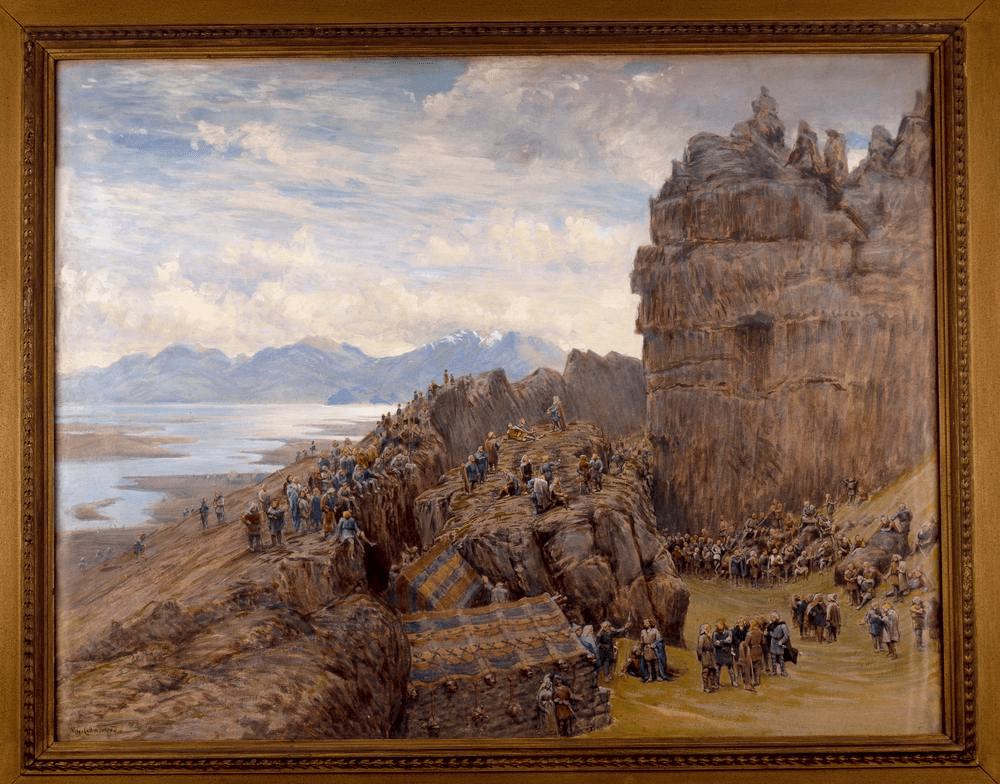
Indeed, the association of king and spear/staff does not stop at mythology. The Lombard kings were elected by the gairethinx–the popular assembly of the Lombard freemen. Gairethinx literally means the assembly of the spears, and its attendees were the arimanni, the army-men. The arimanni affirmed the decisions of the gairethinx by shaking their spears and/or striking them against their shields. We can safely assume that the election of the new king would be a noisy affair.
In addition to lacking a crown, the Lombard king-making ceremony also failed to incorporate another major element of later coronations–the anointing of the king by a Christian religious authority.
We are fortunate to have an account of a Lombard king’s election from Paul the Deacon:
At this time the king himself [Liutprand, 712-744] fell into a great weakness and came near to death. When the Langobards thought that he was departing from life, they raised as their king his nephew Hildeprand, at the church of the Holy Mother of God, which is called “At the Poles,” outside the walls of the city [Pavia, the Lombard capital]. When they handed to him the staff as is the custom, a cuckoo bird came flying and sat down on top of the staff. Then to certain wise persons it appeared to be signified by this portent that his government would be useless.
Paul the Deacon, History of the Lombards (trans. William Dudley Foulke, 1907; ed. Edward Peters, 1974)
Of course, this account relates to a much later period, but it seems to contain all the hallmarks of early king-makings–the assembly of the gairethinx, the outdoor setting (although it’s now associated with a Christian church), and royal regalia (a staff/spear of some kind).
The most interesting detail, however, concerns the omen of the bird. When I first read this passage, I assumed it referred to some sort of augury. But Gasparri proposes a different explanation, one that links quite beautiful with another Lombard custom described by Paul. When a Lombard warrior died far from home, his family would prepare an empty grave for him. Above this, they erected a post topped with the figure of a bird (possibly a dove), which was oriented to face the direction where the dead warrior had fallen. It’s suggested that this bird represented the dead man’s spirit. Gasparri suggests that the bird that alighted on Hildeprand’s spear recalled these funerary posts and presaged his demise. It would be like the US President riding to his inauguration in a hearse.

