At time I started writing this post, the anglophone press was running wall-to-wall stories in anticipation of the coronation of Charles III of the United Kingdom. There’s tons to read about the British regalia, the rituals, the religious ceremony, and cultural symbolism. Which led me to think about the all-important ritual of king-making in the Lombard era. And for once, we know (or can surmise) a fair bit about it!
The first thing to note is that the Lombards didn’t have a coronation…because they didn’t have a crown–at least not in the period I’m concerned with.
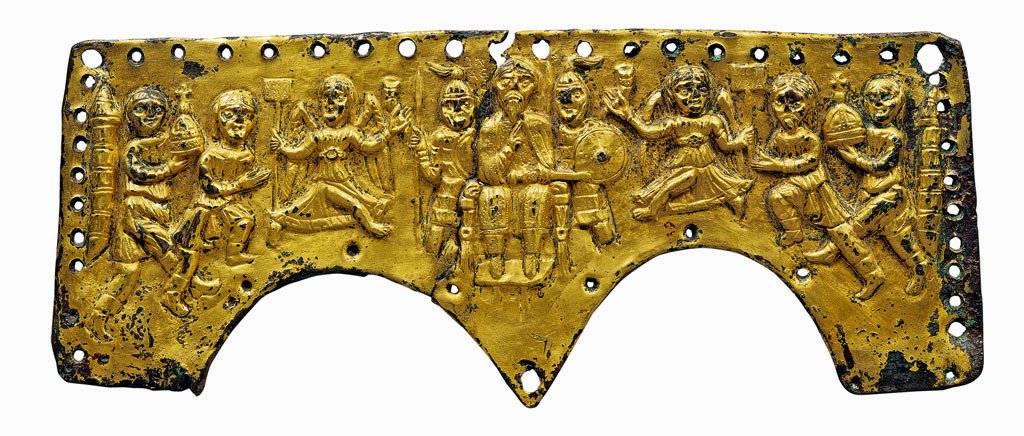
The so-called “Helm of Agilulf” (also known as the Lamina di Valdinievole). It is believed to depict the Lombard king Agilulf (center), flanked by Lombard warriors as he’s presented with offerings. It’s a typically Roman triumphal scene with interesting Lombard elements. For example, the figures of “winged victory” hold drinking horns. Note that Agilulf himself is not wearing a crown or diadem. There is, likewise, a “crown” associated with Agilulf’s queen, Theodelinda, but there’s some debate over whether it was actually hers and, if so, whether it was intended to be worn or offered to a house of worship as a so-called “votive crown.”
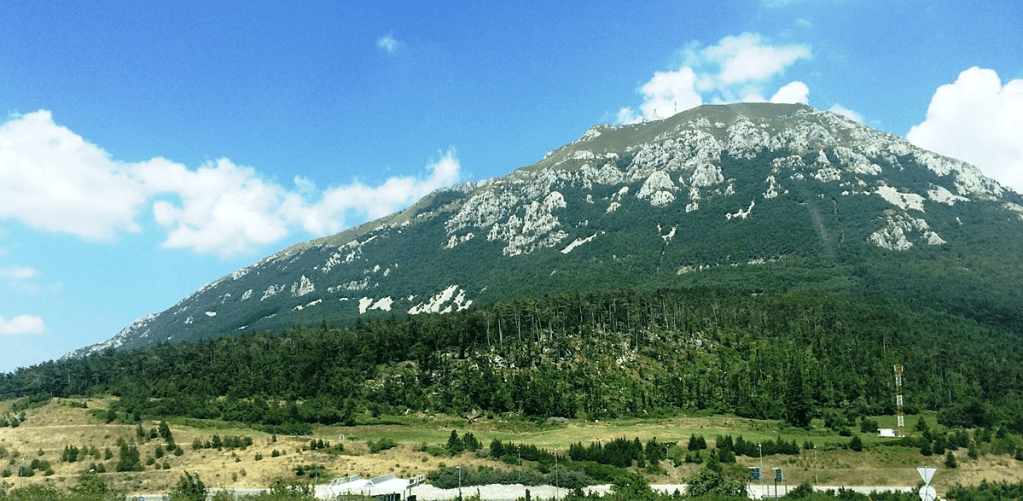
I’ve described the most likely path of the Lombard migration here. There’s just one outstanding question–where exactly is the “King’s Mountain” described by Paul the Deacon?
Therefore, when king Alboin with his whole army and a multitude of people of all kinds had come to the limits of Italy, he ascended a mountain which stands forth in those places, and from there as far as he could see, he gazed upon a portion of Italy. Therefore this mountain it is said, was called from that time on “King’s Mountain.” They say wild oxen graze upon it, and no wonder, since at this point it touches Pannonia, which is productive of those animals….
Paul the Deacon, History of the Lombards, Book 2, ch. 8 (trans. William Dudley Foulke, 1907, ed. Edward Peters 1974)
In this short passage, Paul the Deacon describes the migration of the Lombards into Italy. It seems straightforward enough. We know the journey’s starting point: Pannonia. We know Alboin established the first Italian duchy at Forum Iulii (modern Cividale del Friuli). We have the picturesque detail of the oxen-dotted “King’s mountain.” How difficult could it be to deduce a path that connects these points?
But as ever, nothing is quite as simple as it seems.
You might get the impression reading this blog that Rosamund’s story will be extremely complex and dry. Hopefully that’s not the case! This blog is, in part, a resource for me and a way to organize my thoughts on various topics. I’ve done years of research, and I didn’t stop reading and learning even as I turned to writing in earnest. It’s a lot to keep track of. Forcing myself to pull my notes into some sort of order tends to clarify my thinking.
I try, however, to be judicious about the details I include in the manuscript. I’m not looking to overwhelm a reader, and I absolutely do not assume they have as much interest in this topic as I do. In fact, I linger over the historical details on the blog precisely so that I am not tempted to shoehorn them into the story.
I love well-researched historical fiction. I love a sense of depth and texture and complexity in both historical and fantastic settings. But I have read certain (often otherwise excellent!) novels in which the historical research occasionally overwhelms the characters and plot. I think it’s very easy for a writer who’s done a ton of research–and probably delights in their mastery of the fine details–to succumb to a temptation to share their knowledge or, less charitably, to “show their work.” At best, the inclusion of excessive background information temporarily disrupts the flow of the story. At worst, it can be disorienting and self-indulgent.
Image credit to my husband’s fave governmental agency, NOAA.
To my mind, the research should inform and shape the narrative in ways that aren’t always visible. It should be like an iceberg–90% under the surface. When details are included, they should be in service to the characters and the story. They should shed light on how the characters understand the world and their place in it, how they evaluate their options, and why they take the decisions they ultimately do. Ideally, the reader will sense that the characters spring from a rich cultural substrate without having to dwell on the nitty gritty. Because, ultimately, the story belongs to the characters. Everything I include has to be in service to them.
Which brings me back to this blog. I’m not immune from the desire to show what I’ve learned. Aside from the time and effort expended, I think it’s very interesting! But I also know that most of the information belongs in an appendix, not in the novel proper. This blog is that appendix.
This year, Alboin, King of the Longobards, leaving and burning all of Pannonia, his fatherland, with all his army, with wives and all his people occupied Italy in “fara”; and there some were killed by illness, some by hunger, and others by the sword.
Marius Aventicensis,Chronicon, 569.1 (580)
Writing circa 580, the chronicler Marius Aventicensis recorded that the Lombards arrived in Italy in 569. This is one of the earliest attestations of the Lombard migration and a great example of how scant and tantalizing the sources from this period can be!
Marius Aventicensis says that the Lombards undertook their migration “in fara”–a term which he apparently presumed his audience would understand. In decades past, the word has been the topic of sometimes strenuous debate among historians and philologists. More recently, a groundbreaking paleogenetic investigation has shed new light on this controversial subject, and it is this data that informs my own answer to the perennial question: what exactly was a fara?
The matter of names has proven surprisingly tricky. The first issue is that there’s very little uniformity in the historical record or in the literature as to most of the names in question. For example, Rosamund’s grandfather is variously referred to as Thurisind, Turisind, Torisind, and Thorisind. These are all, most likely, approximations of his actual name, which may have included the components thauris (which probably meant “daring”) and sinþs (“path”) or sinþa (“traveler”). Likewise, Alboin’s actual name was probably something like Albwin–meaning “elf friend.”
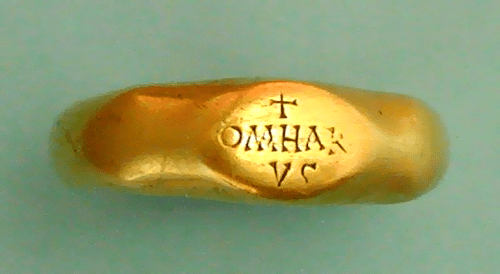
This famous ring is part of the Apahida Treasure, held by the National Museum of Romanian History. The inscription names its presumed owner, Omharus, whose name has been otherwise lost to history. He’s speculated to have been a 5th century Gepidic king who received this ring and other costly treasures as a Roman federate. We don’t know what his name would have been in his native tongue, but it probably incorporated the element harjis (“army”).
All this begs the question: is it a problem if a character has come down to us with a distorted name?
As anyone who’s read this blog can attest, I like history, even the dry, complicated bits. Maybe especially the complicated bits. But even my tolerance has its limit. And that limit is the Controversy of the Three Chapters.
What was the Controversy of the Three Chapters, you may ask? You don’t want to know. Seriously. It’s needlessly complex and boring. One of the greatest descriptions I’ve come across was in Thomas Hodgkin’s magisterial, eight-volume “Italy and Her Invaders,” published in 1896. His work is absolutely out-of-date and in many places inaccurate. Still, Hodgkin writes with inimitable 19th century British flair, his plummy accent practically dripping from the page. To wit:
It is necessary to remind the reluctant reader of that dreary page in ecclesiastical history known as the controversy of the Three Chapters. Most futile and most inept of all the arguments that even ecclesiasticsever wrangled over, that controversy nominally turned on the question whether three Syrian bishops of irreproachable lives, Theodore of Mopsuestia, Theodoret of Cyrrhus, and Ibas of Edessa, were to be stigmatised, a century or more after their deaths, as suffering the punishment of everlasting fire, because the Emperor Justinian, sitting in the library of his palace at the dead of night, and ceaselessly turning over the rolls of the writings of the Fathers, had discovered in the works of these three men the germs of the Nestorian heresy. That was nominally the issue, but as all men knew, something more than this trifling matter was really involved. The writings of these three Syrians had been received without condemnation, if not with actual applause, at the great Council of Chalcedon; and the real question was whether the Eastern Emperors should be allowed to inflict a backhanded blow on the authority of that Council by throwing out the souls of these three hapless Syrians to the Monophysite wolves of Egypt and of Asia, who were for ever howling after the Imperial chariot.
Hodgkin, Italy and Her Invaders, Book V, Chapter 11 (1896)
When I was shopping around my last manuscript to agents, more than one requested songs that related to the story. I’d never really considered musical accompaniment, and I prefer to work in silence so I didn’t even have a writing playlist I could link to. It really threw me for a loop!
This time around, I’ve kept the idea of a soundtrack in back of my mind. Anytime I heard a song that struck the right chord, I threw it into a Spotify playlist. The playlist grew organically from there, and it’s taken on a shape and logic all its own. Weirdly, I do listen to it from time to time to get in the writing mood, especially since it turns out to function like an actual soundtrack, with each song connected to a specific chapter or scene from the story. Most of the tracks feature female vocalists–fitting since the story is told in Rosamund’s voice. Those that feature male voices are the songs I associate with Alboin or the “male perspective” in general. It’s a strange mix of genres–folk, indie rock, electropop, hip-hop, and more. I really had to restrain myself from adding a bunch of 90s gangsta rap to the mix since that somehow seems to tap into the spirit of the time–at least for me!
I had to invent a mother for Rosamund (whose own existence is up for debate in certain quarters, an interesting topic for another day). But what of Alboin’s maternal line? He, at least, is a historical figure, so he must have had a mother.
There are two theories as to her identity. The first–and most prevalent–is that she was a princess, the daughter of the last independent king of the Thuringians. This would make sense. Both Alboin and his father seem to have had some sort of of Thuringian connection.
So far, so simple. But as ever, when you pull on random a thread from this period, a whole host of fascinating stories tumble into view.
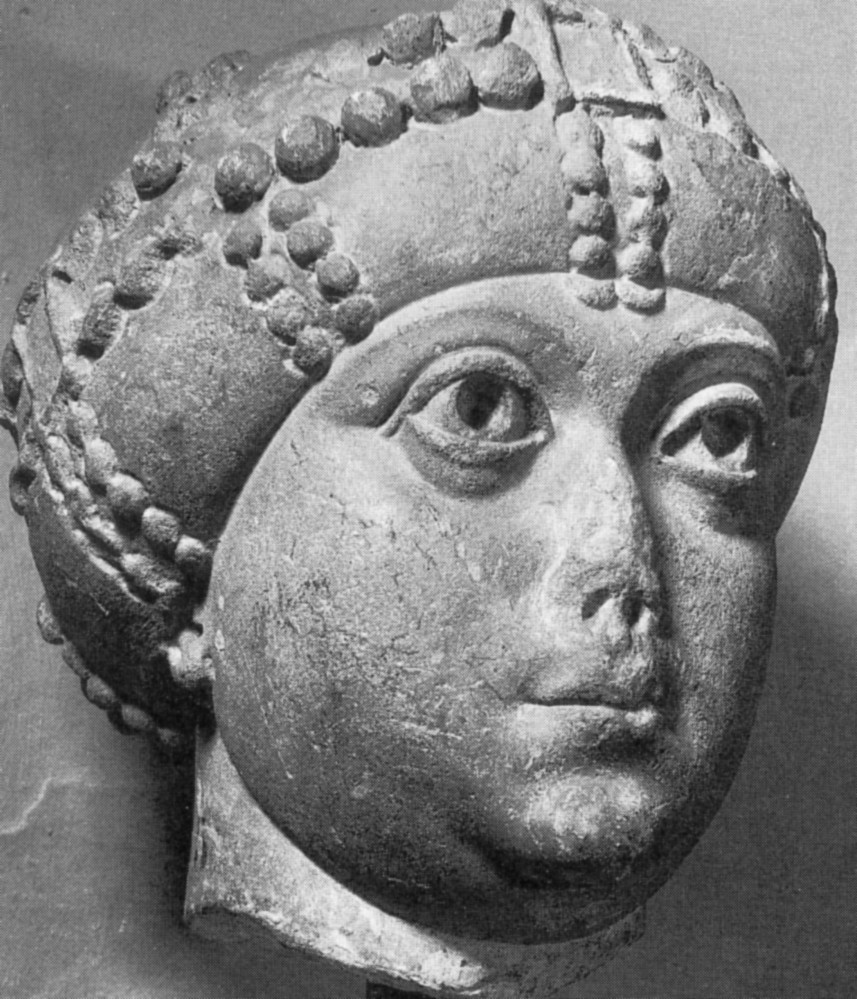
This may be the face of one of her female relatives….Portrait bust of Amalasuintha from the Capitoline Museums, Rome.
The Gothic language is a real challenge for me, especially since I am not a linguist and have no background in Germanic languages. Still, I think the judicious use of Gothic adds a certain flavor to the writing, especially when describing concepts of cultural significance or when use of an English-language term feels especially anachronistic. Of course, the use of Gothic as the language of the Gepids is not without its own issues to take into consideration–a topic I’ve addressed elsewhere.
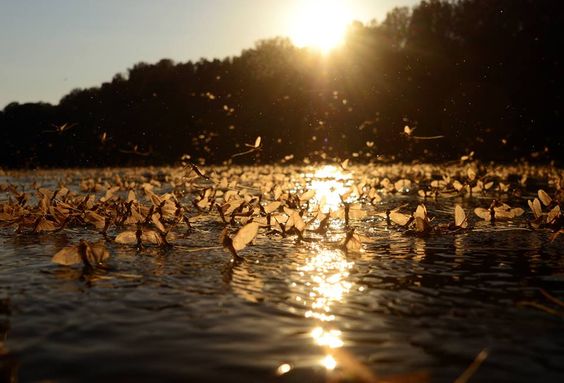
I am currently working on a scene in which Rosamund witnesses the “blooming of the the Tisza”–a natural spectacle which sees millions of long-tailed mayflies (Palingenialongicauda) emerge from their larval phase, mate, and die, all in a matter of hours. But as I prepared to write, I faced a quandary: what would Rosamund call a mayfly?

 A Queen's Cup
