Rosamund was a princess of a people known as the Gepids, who lived north of the Danube and east of the Tisza in the early- to mid-6th century. The Gepids were one of the more prominent tribes of the so-called Migration Era, which saw large-scale movements of human populations across Europe. This is the period that saw Ostrogoths and Lombards in Italy, Franks in Gaul, Visigoths in Spain, and Vandals in North Africa, to say nothing of the “smaller” tribes. You might remember it from some very startling (and frankly confusing) maps in your high school history book that involved arrows meandering all over Europe.
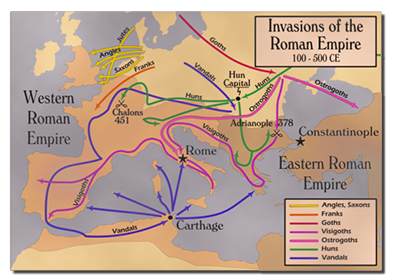
The Gepids are a particularly mysterious group. They left no documents, no monuments. Their settlements were built from ephemeral materials and left only subtle traces–the occasional hearth, post holes, and loom weights. They did have a habit of burying their treasure in times of stress, which has led to accidental discoveries of phenomenal quality. Their tombs have been plundered and pillaged for hundreds of years and are often so disturbed that the dead no longer speak to us clearly.
Their precise origin remains a mystery. The Romans considered them relatives of the Goths, and that is how I have decided to treat them. Unlike the Goths, the Gepids never transplanted the nucleus of their society into Roman territory, and as a result, the Romans have relatively little to say about them. By the time they reached the zenith of their power in the 6th century, they were a threat on the eastern empire’s doorstep, and descriptions of them smack of disparaging political propaganda.
There does seem to be some consensus in the historical record that Rosamund was the daughter of Cunimund, the last king of the Gepids. She was probably born around 552 somewhere on the Hungarian Plain. We do not know the name of her mother or any siblings. The Gepids fought several wars with their neighbors to the west, the Lombards. In 567, the Gepids suffered a catastrophic and total defeat. Alboin, the king of the Lombards, killed Rosamund’s father in battle, took her captive, and married her shortly thereafter. The next year, Alboin led a large-scale migration of Lombards and various other peoples into Italy, bringing Rosamund with him as his reluctant queen. The Lombards quickly gained control of large swaths of Italy, especially along the Po River.
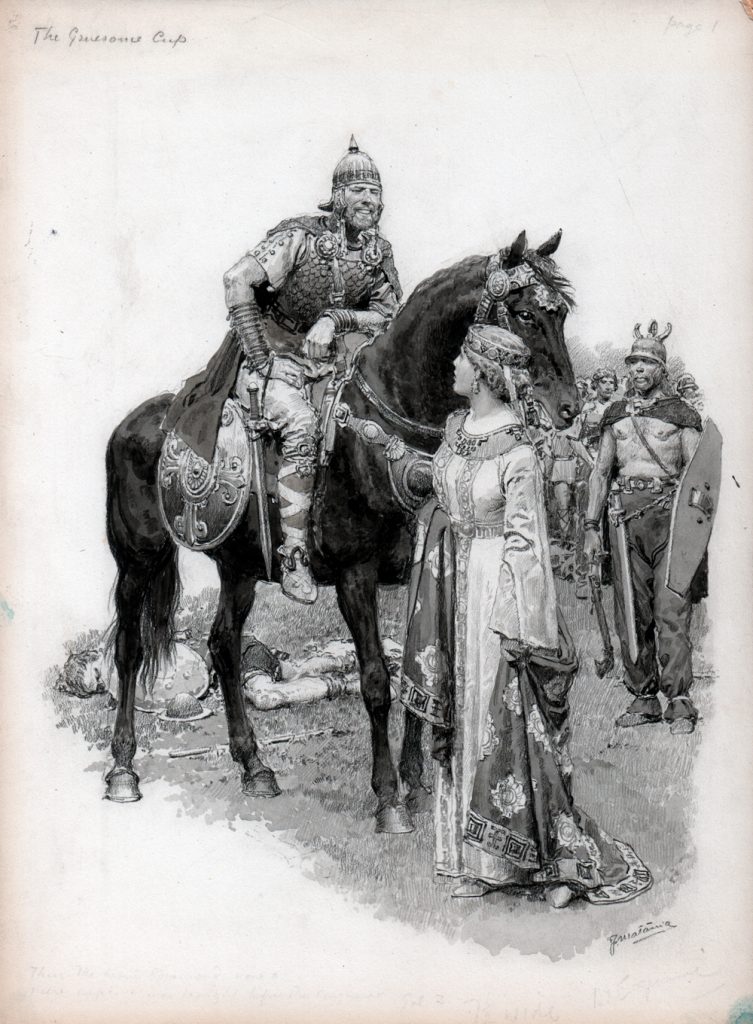
Then Alboin made a fateful mistake. At a feast, he compelled Rosamund to drink from a cup made from her own father’s skull. Incensed, she became the linchpin of a plot to assassinate Alboin. After she succeeded in exacting her vengeance, she quickly married a co-conspirator and contrived to have him named king in Alboin’s place. The Lombards were outraged. Rosamund and her new husband were forced to flee. Some sources state simply that they were “overtaken” and killed. Others suggest that they made their way the Byzantine exarchate in Ravenna, where they soon turned on each other. Whatever the case, Rosamund died in 572. She would have been about 20 years old.
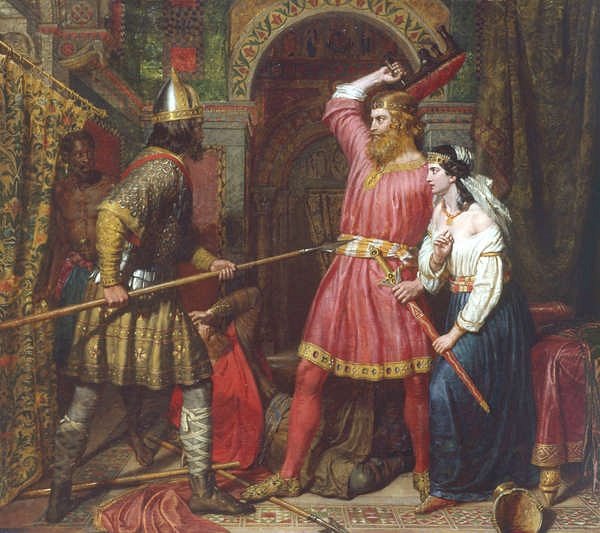
These are the barest bones of Rosamund’s story. It was a popular subject of folktales, poems, and songs up to the 19th century. It’s a tale of loss, tragedy, and vengeance–usually with a generous dash of sex and seduction for spice–but one in which the femme fatale is ultimately punished for her blood-thirst.
My goal is to peel back the romanticized elements of this oft-told tale to reveal the characters and cultures that might lie beneath. Which is not to say there won’t be plenty of sex, death, and vengeance! I do, however, want to present a version of events that doesn’t immediately bring to mind a zaftig soprano in a horned helmet. I cannot say I’m trying to tell “the true story.” With so little to go on, that would be impossible. But I have endeavored to tell this story in a different way, and in the process shed some light on a tragic tale lifted from the “dark ages.”


What a captivating story. I’m already hooked!
LikeLike
Awesome! Thanks for checking it out. There’s more to come!
LikeLike