An esoteric ecclesiastic excision?

As anyone who’s read this blog can attest, I like history, even the dry, complicated bits. Maybe especially the complicated bits. But even my tolerance has its limit. And that limit is the Controversy of the Three Chapters.

What was the Controversy of the Three Chapters, you may ask? You don’t want to know. Seriously. It’s needlessly complex and boring. One of the greatest descriptions I’ve come across was in Thomas Hodgkin’s magisterial, eight-volume “Italy and Her Invaders,” published in 1896. His work is absolutely out-of-date and in many places inaccurate. Still, Hodgkin writes with inimitable 19th century British flair, his plummy accent practically dripping from the page. To wit:

It is necessary to remind the reluctant reader of that dreary page in ecclesiastical history known as the controversy of the Three Chapters.​ Most futile and most inept of all the arguments that even ecclesiastics ever wrangled over, that controversy nominally turned on the question whether three Syrian bishops of irreproachable lives, Theodore of Mopsuestia, Theodoret of Cyrrhus, and Ibas of Edessa, were to be stigmatised, a century or more after their deaths, as suffering the punishment of everlasting fire, because the Emperor Justinian, sitting in the library of his palace at the dead of night, and ceaselessly turning over the rolls of the writings of the Fathers, had discovered in the works of these three men the germs of the Nestorian heresy. That was nominally the issue, but as all men knew, something more than this trifling matter was really involved. The writings of these three Syrians had been received without condemnation, if not with actual applause, at the great Council of Chalcedon; and the real question was whether the Eastern Emperors should be allowed to inflict a backhanded blow on the authority of that Council by throwing out the souls of these three hapless Syrians to the Monophysite wolves of Egypt and of Asia, who were for ever howling after the Imperial chariot.

Hodgkin, Italy and Her Invaders, Book V, Chapter 11 (1896)
Continue reading

The Grubenhaus of Babel

What language did the Gepids speak? They left no written traces that would provide an answer to this simple question. It is possible they spoke a Gothic dialect, but if so, how similar was their spoken language to the what we know of Gothic based on limited written survivals?

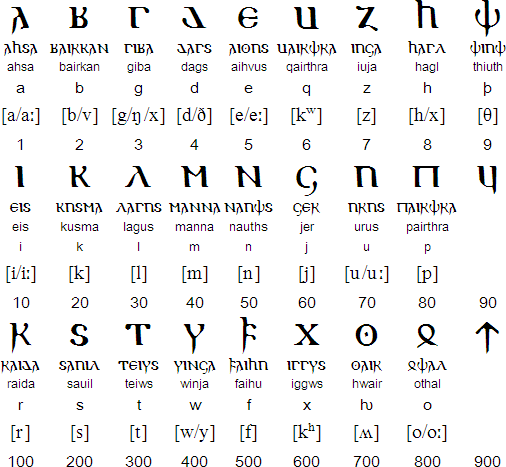
The Gothic alphabet, via omniglot.com

Most of what we know about the Gothic language comes from a few fragments of the Gothic-language Bible, which was first translated under the supervision of a bishop named Ulfilas. (Incidentally, most of these these precious codices are 6th century copies of older manuscripts that have not survived.) Ulfilas (Wulfila in Gothic) was the son of Christian Greeks captured by Goths. He was, thus, raised with a foot in two worlds. He eventually became a priest and a missionary among the Goths, converting many of them to Christianity in the 4th century. As part of his work, Ulfilas decided to translate the Greek bible into Gothic, but first, he needed to devise a Gothic alphabet. His letters seem to draw on Greek, Latin, and Runic influences.

Continue reading

A rose by any other name

The name Rosamund remains in current usage, though my impression is that it was more popular in the past. It evokes the Latin phrase rosa mundi (“rose of the world”). In the Greco-Roman world, the rose was a significant flower. It was said to have been created when the goddess of love pricked herself on thorns while rushing to her lover–the flower’s blush evoked divine bloodshed and lust. During the dies rosationis, Romans honored the dead by placing roses on the graves of their ancestors, and various rose festivals were held during the blooming season. Roses were dichotomous symbols representing both beauty and blood, pleasure and death, remembrance and rebirth.

The symbolism of the rose took on new valences with the advent of Christianity. Coelius Sedelius, a Christian poet writing in Latin in the 5th century, used the rose to draw a metaphoric parallel between Eve and the Virgin Mary. Already in the 3rd century, Saint Ambrose postulated that roses only acquired thorns after Adam and Eve’s expulsion from Eden, the thorn itself a manifestation of Eve’s original sin. Coelius Sedelius built on this metaphor, depicting Mary as “the rose without thorn” since she was born through immaculate conception, without the stain of original sin. She became the rosa munda–the “pure rose.”

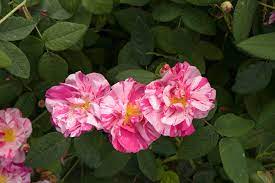
Rosa mundi, an heirloom variety of rose with a dramatic look and romantic folk history

Rosamund’s name, however, is unlikely to take its meaning from either the Latin or Marian rosa. Rather, it probably bears some connection to the reconstructed Proto-Germanic word for “horse”–hrussą. This word filtered into many later languages. In Old English, a horse was hors, in Old Saxon hros, and in Old High German ros. A cognate for “horse” in Gothic/Gepidic could explain the first element in Rosamund’s name. There’s just one small problem.

Continue reading