Women’s Traces, Part 2: The missing mother

While we know that Rosamund was supposedly the daughter of Cunimund, last king of the Gepids, her mother is never named in the sources. Her absence leaves an intriguing opening in the story, which I’ve seen fit to fill.

I’ve invented a highly speculative backstory for Rosamund’s mother by weaving together a number of historical threads. First, I had to decide on her “ethnicity.” Rosamund’s parents would have married sometime in the 540s, around the time when Cunimund’s father–Thurisind–became king. Thurisind usurped the Gepid throne from the previous king’s son. Thus, his kingship–and his new dynasty–may have been on somewhat shaky ground. For that reason, I suspect that Cunimund’s marriage would have had a political implications. Most logically, the union would have either (1) sealed an alliance with a powerful Gepid clan, thus shoring up internal support for the new regime OR (2) secured a useful alliance with an external group that could under-gird the new dynasty’s power and legitimacy. Since we know next to nothing about the internal politics of the Gepids, I decided to construct a heritage for Rosamund’s mother outside the Gepid gens.
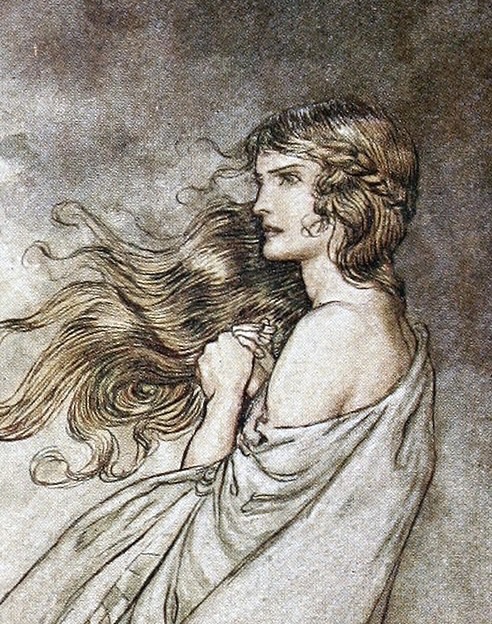
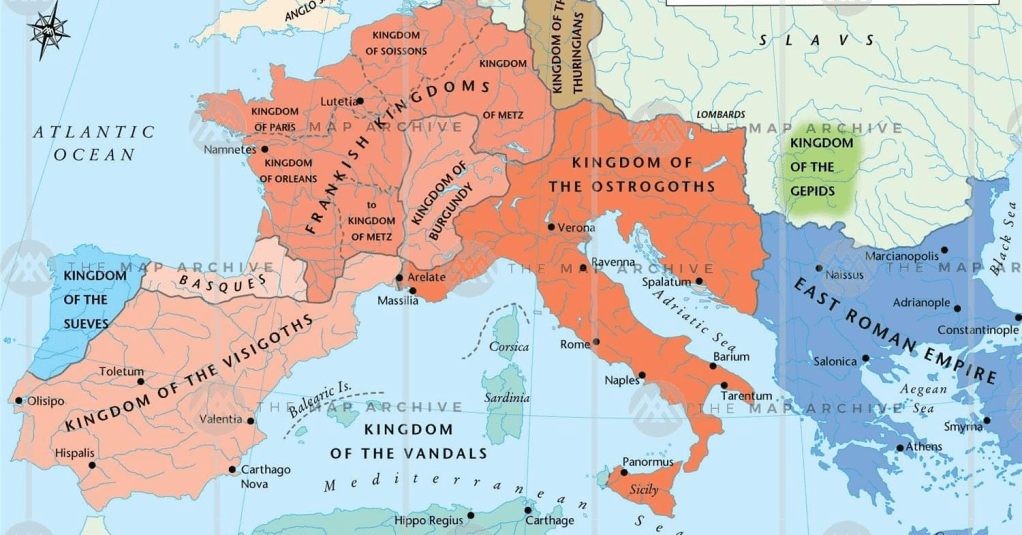
Image taken from Arthur Rackham’s gorgeous illustrations of the Ring Cycle. This is his Brunhilde, a fierce heroine of Germanic legend, possible inspired by an actual 6th century queen of the same name.
Continue reading

The Gepid State, Part 2–Searching for the Invisible

It’s hard to overstate how many hours I’ve lost to contemplation of Gepid political organization. Yet even after all this time (and all that I’ve written,) it remains illusive. The facts simply do not survive. I’m left with my own speculation built on whatever comparisons seem appropriate.

So which comparisons are fruitful to explore? Even that is up for debate. Obviously, there’s some attraction to considering Ostrogothic and Visigothic political organization, especially since I’ve decided to treat the Gepids as a “Gothic” tribe. And conveniently, the documentation for both these kingdoms is relatively robust. Among other sources, Euric’s Code gives insight into the Visigoths in the late 5th century while Cassiodorus’s Variae does likewise for early 6th century Ostrogothic Italy.

So why not simply import these military, civil, and court structures and call it a day?

Continue reading

Who were the Gepids, Really? New Clues!

Paleogenetics–the collection, analysis, and interpretation of ancient DNA–sheds new light on the movement and interaction of human populations. The bodies of the dead can sometimes speak, even when their graves are disturbed and the historical record is silent. So I was extremely interested to read a recent paper, Maternal Lineages of Gepids from Transylvania by Alexandra Gîngută, et als., published in the journal Genes.

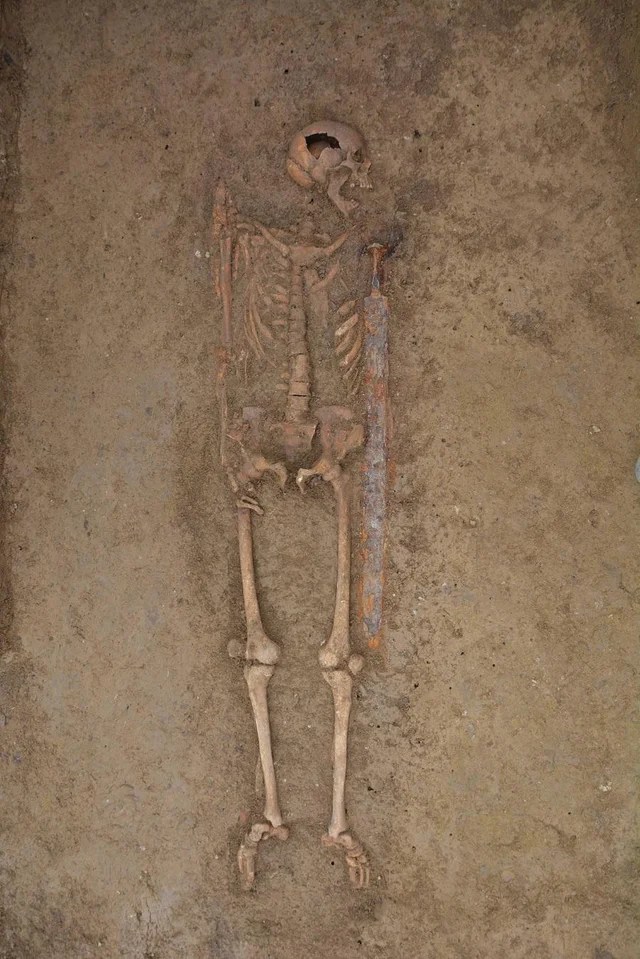
Grave a Gepid man, discovered in Serbia in 2019. Photo via National Geographic Srbija (https://nationalgeographic.rs/priroda/zemlja/a24230/veliko-otkrice-u-viminacijumu-pronadjen-grob-pripadnika-gepida-foto.html)
Continue reading

Women’s traces, Part 1: Alboin’s Sister

Widsið maðolade, wordhord onleac,
se þe monna mæst mægþa ofer eorþan,
folca geondferde; oft he on flette geþah
mynelicne maþþum. Him from Myrgingum
æþele onwocon. He mid Ealhhilde,
fælre freoþuwebban, forman siþe
Hreðcyninges ham gesohte
eastan of Ongle, Eormanrices,
wraþes wærlogan. Ongon þa worn sprecan
Widsith spoke, unlocked his word-hoard,
he who had traveled most of all men
through tribes and nations across the earth.
Often he had gained great treasure in hall.
He belonged by birth to the Myrging tribe.
Along with Ealhild, the kind peace-weaver,
for the first time, east of the Angle,
he sought the home of Eormanric,
king of the Ostrogoths, hostile to traitors.
He began then to speak at length:
….
Swylce ic wæs on Eatule mid ælfwine,
se hæfde moncynnes, mine gefræge,
leohteste hond lofes to wyrcenne,
heortan unhneaweste hringa gedales, beorhtra beaga, bearn Eadwines.


I was in Italy with Aelfwine too:
of all men he had, as I have heard, the readiest hand to do brave deeds,
the most generous heart in giving out rings
and shining torcs, Eadwine’s son.
     
….  
Ond me þa Ealhhild oþerne forgeaf,
dryhtcwen duguþe, dohtor Eadwines.
Hyre lof lengde geond londa fela,
þonne ic be songe secgan sceolde
hwær ic under swegle selast wisse
goldhrodene cwen giefe bryttian.  

And then Ealhhild, Eadwine’s daughter,
noble queen of the household, gave me another;
her fame extended through many lands
when I used my song to spread the word
of where under the heavens I knew a queen,
adorned with gold, most generous of all.
Widsith, ln. 1-9, 71-75, & 97-102 (Transl. soton.ac.uk/~enm/widsith.htm

The preferred histriographic term for Rosamund’s era is “late antique” or “early medieval.” The old descriptor–“the Dark Ages”–with its ominous insinuation of ignorance, brutality, and decline, has fallen out of favor. And yet, this term persists in the popular imagination.

But if the 6th century of Rosamund and Alboin is dark, that is mostly down to our ignorance, not theirs. Very few primary sources from the early middle ages survive. There are many things we simply do not–and cannot–know . But this profound obscurity makes the sources we do have all the more precious and intriguing.

Continue reading

The cup(s) in question–Part 3

The traditional version of Rosamund’s story is quite straightforward: the proud princess, the tragic fall, revenge, betrayal, death. Although it makes for an exciting story, it all strikes me as a little too neat.

I believe there is another story hidden between the lines of the legend, one that sheds light on the politics and culture of Rosamund’s time. Obviously, this is deeply speculative on my part. But it’s also the aspect of Rosamund’s tale that I find most intriguing. Songs and poems and plays have presented the “Tragedy of Alboin and Rosamund.” I want a glimpse of the gritty, foreign reality lurking behind the legend.

This requires analysis, not only of Rosamund’s experience, but that of her contemporaries. I believe that close examination can reveal elements of their reality that would otherwise remain obscure.

Continue reading

The Gepid State, Part 1–Models of kingship

Nothing has caused me more of a headache than trying to imagine the political organization of the Gepids. Very little is known about it, aside from a few stray comments in various sources. We know that they had a king, and at various times there may have been more than one. There was, apparently, some sort of a council of nobles or tribal chiefs that had influence over certain military and political decisions. Beyond that, little can be known for certain.

Frankish King Clovis I (~466-511) dictates to a scribe, attended by his retainers and a rather unfriendly hound. Facsimile of an illumination from the 14th century Grandes Chroniques de Saint-Denis.

Other “states” (loosely defined!) of the time are somewhat less mysterious. We have a sense of the complex court and political offices of the Eastern Empire. Among the “barbarians,” the Merovingian court is relatively well documented, but due to the particular circumstances in Frankish kingdom, this many not shed much light on the organization of the Gepids around the same time. The Franks, after all, incorporated a Gallo-Roman elite and Catholic ecclesiastics into their administrative state. I’ve seen no evidence that these factors were present to a significant degree in “Gepidia.” Indeed, for a time the Gepids may have engaged in a project of constituting themselves as a political and ethnic body precisely in contrast to Roman precedent.

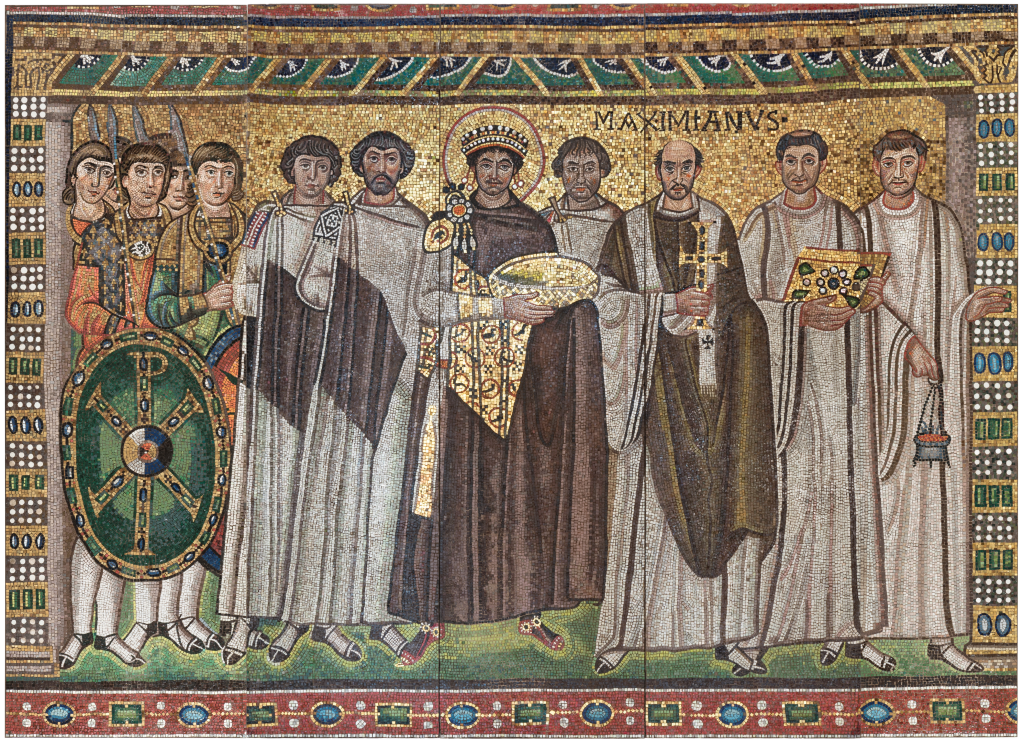
The Eastern Roman Emperor Justinian, flanked by members of the imperial court. We see religious officers, aristocrats, and armed retainers. 6th Century mosaic from the Basilica of San Vitale in Ravenna.

Yet surely there was a Gepidic court. Even Attila had secretaries, after all.

Continue reading

The Grubenhaus of Babel

What language did the Gepids speak? They left no written traces that would provide an answer to this simple question. It is possible they spoke a Gothic dialect, but if so, how similar was their spoken language to the what we know of Gothic based on limited written survivals?

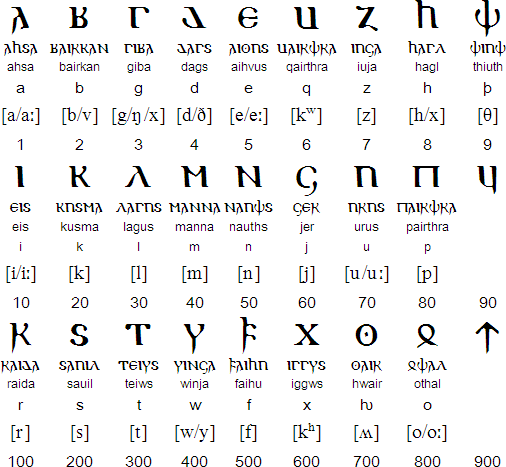
The Gothic alphabet, via omniglot.com

Most of what we know about the Gothic language comes from a few fragments of the Gothic-language Bible, which was first translated under the supervision of a bishop named Ulfilas. (Incidentally, most of these these precious codices are 6th century copies of older manuscripts that have not survived.) Ulfilas (Wulfila in Gothic) was the son of Christian Greeks captured by Goths. He was, thus, raised with a foot in two worlds. He eventually became a priest and a missionary among the Goths, converting many of them to Christianity in the 4th century. As part of his work, Ulfilas decided to translate the Greek bible into Gothic, but first, he needed to devise a Gothic alphabet. His letters seem to draw on Greek, Latin, and Runic influences.

Continue reading

When a crazy idea is too good to resist

Sometime around the year 600, a Gepid mercenary committed murder . His victim was a bodyguard of the Emperor Maurice who had been taking part in an impromptu deer hunt. When the bodyguard became separated from the other hunters, the Gepid fell upon him and threw his body into a nearby ravine. The motive: greed. From his victim, the Gepid took a precious golden belt.

From the collection of the Metropolitan Museum: “This incomplete, massive gold girdle composed of a series of solidi (gold coins) and medallions may have been worn as an insignia of office. The four medallions depicting the emperor Maurice Tiberius (r. 582–602) probably were minted for him to present as gifts to high officials and nobles when he assumed the office of consul in 583.”
Continue reading

The cup(s) in question–Part 2

In this battle Alboin killed Cunimund, and made out of his head, which he carried off, a drinking goblet. This kind of a goblet is called among them “scala,” but in the Latin language “patera.”

Paul the Deacon, History of the Lombards, Book I, Chapter XXVII

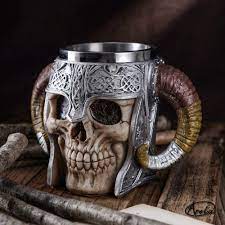
The most infamous cup in Rosamund’s tale is surely the one fashioned from her father’s skull. When I first read about it, I definitely imagined something (for lack of a better word…) goth–appropriate for what I took to be a particularly macabre trophy.

But upon further research, I realized my initial impressions were probably pretty far off-base–both in terms of the cup’s likely form and its significance.

Continue reading

Rosamund’s Sirmium

Rosamund would have presumably spent some amount of time in Sirmium (now Sremska Mitrovika, Serbia), which was under Gepid control in the mid-6th century. This city on the banks of the Sava was once the capital of the Roman province of Pannonia Inferior and, in the 3rd-century, served as a capital of the empire. It boasted forums, basilicas, enormous baths, an aqueduct, a hippodrome, an imperial palace complex, a fortified circuit wall, an extramural necropolis, and numerous urban villas, to say nothing of its more workaday businesses, marketplaces, and habitations. In its heyday, it would have looked something like this…

A model from the museum in Sremska Mitrovika

There aren’t many novels set in this part of the world in the 5th and 6th centuries (at least in English), but those that I’ve been able to find seem to treat Sirmium as a bastion of Roman society, its glory tarnished by the travails of history but still largely intact. My research suggests this was far from the case.

Continue reading