The matter of names has proven surprisingly tricky. The first issue is that there’s very little uniformity in the historical record or in the literature as to most of the names in question. For example, Rosamund’s grandfather is variously referred to as Thurisind, Turisind, Torisind, and Thorisind. These are all, most likely, approximations of his actual name, which may have included the components thauris (which probably meant “daring”) and sinþs (“path”) or sinþa (“traveler”). Likewise, Alboin’s actual name was probably something like Albwin–meaning “elf friend.”
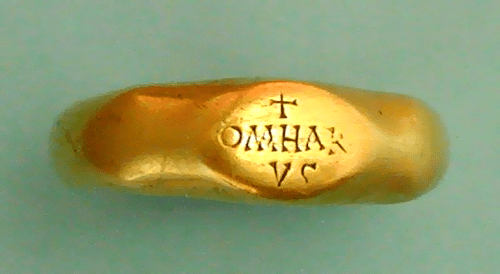
This famous ring is part of the Apahida Treasure, held by the National Museum of Romanian History. The inscription names its presumed owner, Omharus, whose name has been otherwise lost to history. He’s speculated to have been a 5th century Gepidic king who received this ring and other costly treasures as a Roman federate. We don’t know what his name would have been in his native tongue, but it probably incorporated the element harjis (“army”).
All this begs the question: is it a problem if a character has come down to us with a distorted name?
The Gothic language is a real challenge for me, especially since I am not a linguist and have no background in Germanic languages. Still, I think the judicious use of Gothic adds a certain flavor to the writing, especially when describing concepts of cultural significance or when use of an English-language term feels especially anachronistic. Of course, the use of Gothic as the language of the Gepids is not without its own issues to take into consideration–a topic I’ve addressed elsewhere.
I am currently working on a scene in which Rosamund witnesses the “blooming of the the Tisza”–a natural spectacle which sees millions of long-tailed mayflies (Palingenialongicauda) emerge from their larval phase, mate, and die, all in a matter of hours. But as I prepared to write, I faced a quandary: what would Rosamund call a mayfly?
The name Rosamund remains in current usage, though my impression is that it was more popular in the past. It evokes the Latin phrase rosa mundi (“rose of the world”). In the Greco-Roman world, the rose was a significant flower. It was said to have been created when the goddess of love pricked herself on thorns while rushing to her lover–the flower’s blush evoked divine bloodshed and lust. During the dies rosationis, Romans honored the dead by placing roses on the graves of their ancestors, and various rose festivals were held during the blooming season. Roses were dichotomous symbols representing both beauty and blood, pleasure and death, remembrance and rebirth.
The symbolism of the rose took on new valences with the advent of Christianity. Coelius Sedelius, a Christian poet writing in Latin in the 5th century, used the rose to draw a metaphoric parallel between Eve and the Virgin Mary. Already in the 3rd century, Saint Ambrose postulated that roses only acquired thorns after Adam and Eve’s expulsion from Eden, the thorn itself a manifestation of Eve’s original sin. Coelius Sedelius built on this metaphor, depicting Mary as “the rose without thorn” since she was born through immaculate conception, without the stain of original sin. She became the rosa munda–the “pure rose.”
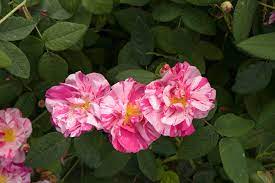
Rosa mundi, an heirloom variety of rose with a dramatic look and romantic folk history
Rosamund’s name, however, is unlikely to take its meaning from either the Latin or Marian rosa. Rather, it probably bears some connection to the reconstructed Proto-Germanic word for “horse”–hrussą. This word filtered into many later languages. In Old English, a horse was hors, in Old Saxon hros, and in Old High German ros. A cognate for “horse” in Gothic/Gepidic could explain the first element in Rosamund’s name. There’s just one small problem.

 A Queen's Cup