The Gothic language is a real challenge for me, especially since I am not a linguist and have no background in Germanic languages. Still, I think the judicious use of Gothic adds a certain flavor to the writing, especially when describing concepts of cultural significance or when use of an English-language term feels especially anachronistic. Of course, the use of Gothic as the language of the Gepids is not without its own issues to take into consideration–a topic I’ve addressed elsewhere.
I am currently working on a scene in which Rosamund witnesses the “blooming of the the Tisza”–a natural spectacle which sees millions of long-tailed mayflies (Palingenialongicauda) emerge from their larval phase, mate, and die, all in a matter of hours. But as I prepared to write, I faced a quandary: what would Rosamund call a mayfly?
Cunimund (and possibly Thurisind) supposedly minted silver coins (half-siliqua, quarter-siliqua) in the style of Roman currency in Sirmium. The Ostrogoths first restarted the Roman mint in Sirmium when they occupied the city between about 505 and 535. Coins from the period of Ostrogothic occupation commonly bear the names of the then-ruling Roman emperor on the obverse, and the monogram of Theoderic, the Ostrogothic king, on the reverse. They definitely struck coins in the name of Anastasius (491-518) and Justin I (518-527), and it is possible they minted coins during the first years of Justinian’s rule beginning in 527.
Despite the caption, this was almost certainly an Ostrogothic coin; note the name of Emperor Anastasius on the obverse and the monogram of Theoderic on the reverse. The inscription on reverse reads INVICTA ROMA (“invincible Rome”)
It appears minting operations ceased for a time during the transition from Ostrogothic to Gepidic control of the city, about 527-535. The exact date of the Gepid takeover is not definitively known, but the earliest possible date for resumption of minting activity would be around 536. Either Thurisind or Cunimund may have struck coins in the name of Justinian, and Cunimund may have struck coins in the name of Justin II (565-576) for a brief time before the destruction of the Gepid state in 567.
A final figure of note must be the queen. Fundamentally, a queen was simply the wife of a king. She need not be his only official sexual partner. Kings of the early medieval period sometimes kept recognized concubines. Some even had multiple wives. Regardless of personal arrangements, the queen took precedence over the other women in the king’s orbit.
In the 6th century, the position of queen was essentially personal. She was not anointed in a special ceremony that we know of. A woman became queen when she married a king–provided that was her husband’s will. But marriage itself was less “hard and fast” in those days. In a Christian context, marriage was not a sacrament, and divorce was no taboo in the “barbarian” traditions. The position of queen was, therefore, inherently precarious.
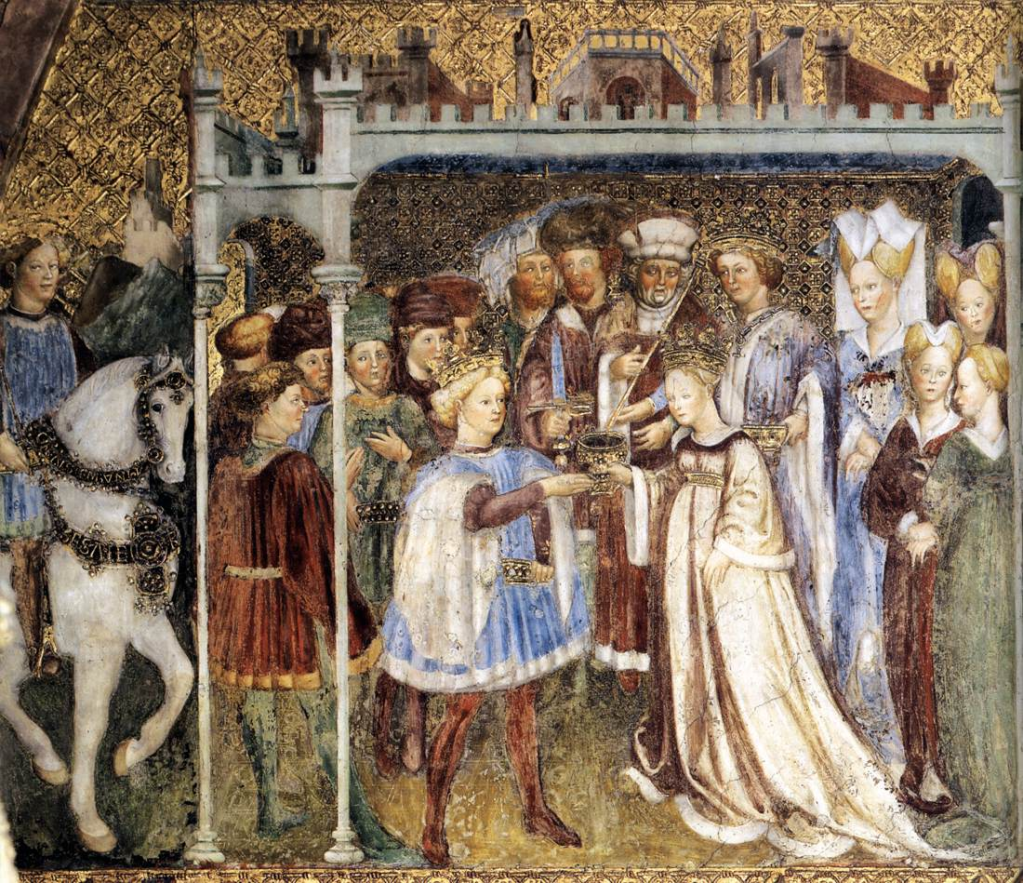
In a chapel in Monza Cathedral, frescoes depict the life of Lombard Queen Theodelinda. In this scene, Theodelinda meets her royal husband-to-be and, significantly, offers him refreshment. Zavattari & sons, 1444.
The Gepid kingdom ultimately succumbed to an alliance between the Lombards and the Avars. The Avars were relative newcomers on the eastern European scene. Their origins have long been shrouded in mystery, but the prevailing theory proposes that they were refugees from the Rouran Empire of the Mongolian steppe, which had been overthrown by the Göktürks. For over a thousand years, their true origins were a mystery waiting to be solved.
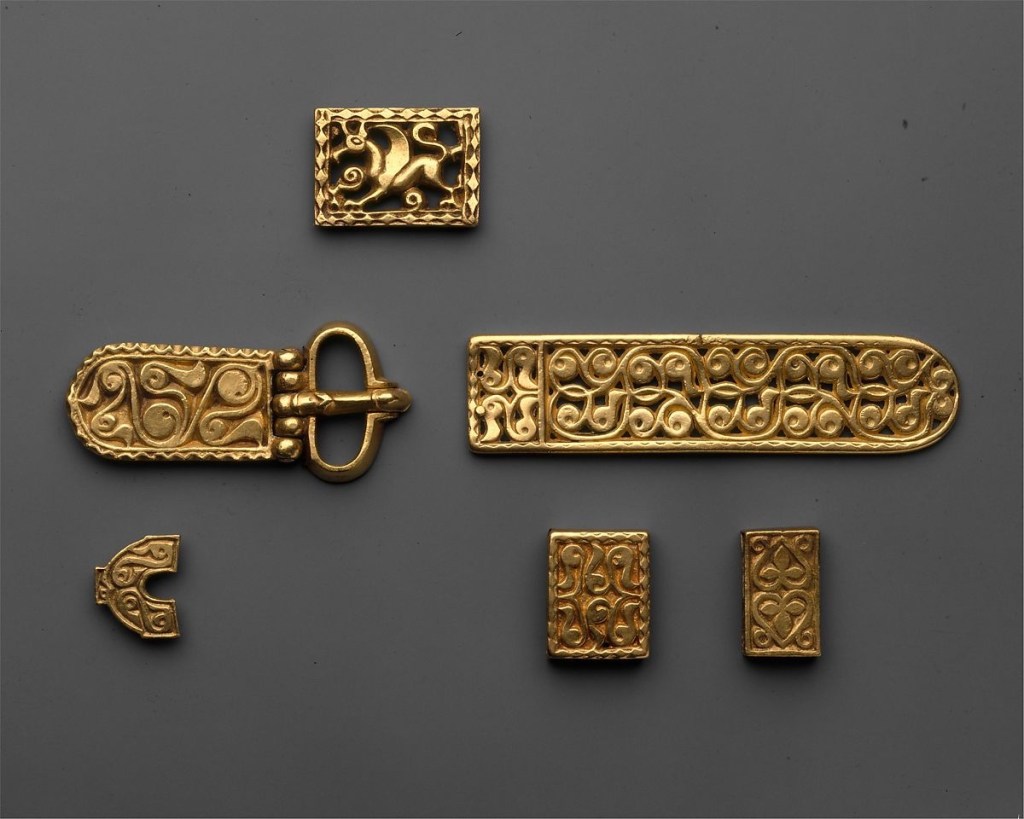
8th century Avar belt fittings, including a belt mount with the figure of a winged horse or griffin. Image via the Met Museum.
It’s hard to overstate how many hours I’ve lost to contemplation of Gepid political organization. Yet even after all this time (and all that I’ve written,) it remains illusive. The facts simply do not survive. I’m left with my own speculation built on whatever comparisons seem appropriate.
So which comparisons are fruitful to explore? Even that is up for debate. Obviously, there’s some attraction to considering Ostrogothic and Visigothic political organization, especially since I’ve decided to treat the Gepids as a “Gothic” tribe. And conveniently, the documentation for both these kingdoms is relatively robust. Among other sources, Euric’s Code gives insight into the Visigoths in the late 5th century while Cassiodorus’s Variae does likewise for early 6th century Ostrogothic Italy.
So why not simply import these military, civil, and court structures and call it a day?
Paleogenetics–the collection, analysis, and interpretation of ancient DNA–sheds new light on the movement and interaction of human populations. The bodies of the dead can sometimes speak, even when their graves are disturbed and the historical record is silent. So I was extremely interested to read a recent paper, Maternal Lineages of Gepids from Transylvania by Alexandra Gîngută, et als., published in the journal Genes.
Nothing has caused me more of a headache than trying to imagine the political organization of the Gepids. Very little is known about it, aside from a few stray comments in various sources. We know that they had a king, and at various times there may have been more than one. There was, apparently, some sort of a council of nobles or tribal chiefs that had influence over certain military and political decisions. Beyond that, little can be known for certain.
Frankish King Clovis I (~466-511) dictates to a scribe, attended by his retainers and a rather unfriendly hound. Facsimile of an illumination from the 14th century Grandes Chroniques de Saint-Denis.
Other “states” (loosely defined!) of the time are somewhat less mysterious. We have a sense of the complex court and political offices of the Eastern Empire. Among the “barbarians,” the Merovingian court is relatively well documented, but due to the particular circumstances in Frankish kingdom, this many not shed much light on the organization of the Gepids around the same time. The Franks, after all, incorporated a Gallo-Roman elite and Catholic ecclesiastics into their administrative state. I’ve seen no evidence that these factors were present to a significant degree in “Gepidia.” Indeed, for a time the Gepids may have engaged in a project of constituting themselves as a political and ethnic body precisely in contrast to Roman precedent.
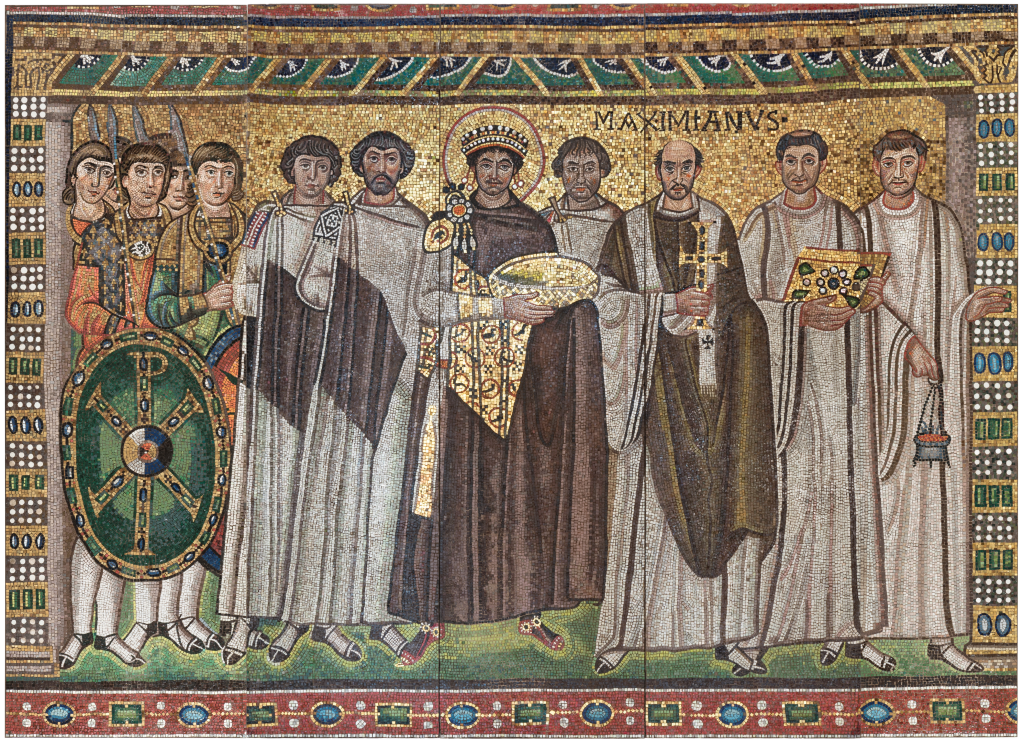
The Eastern Roman Emperor Justinian, flanked by members of the imperial court. We see religious officers, aristocrats, and armed retainers. 6th Century mosaic from the Basilica of San Vitale in Ravenna.
Yet surely there was a Gepidic court. Even Attila had secretaries, after all.
As I prepared to write Rosamund’s story, one of my first tasks was to place her in a political and geographical context.
A topographical view of the relevant region. The sickle-shape of the rugged Carpathians served as a natural bulwark for peoples settled on the Great Hungarian Plain (also known as the Pannonian Basin/Carpathian Basin). Strategic earthworks constructed by the Romans in the 4th century may have provided an additional, man-made line of defense.
When the Gepids first appear in the historical record, they reside along the upper reaches of the Tisza River. This would have been a less than ideal environment, pressed up against the mountains and exposed to peoples funneling off the steppes into the Great Hungarian Plain. The bulk of their population probably remained in this area throughout the period of domination under the Huns. They would have served as a sort of buffer nation. Along with the Goths, they were supposedly the Germanic tribe most favored by Attila. The proximity of their settlement area to nucleus of Attila’s empire on the Hungarian plain probably reflects this preferred status.
What language did the Gepids speak? They left no written traces that would provide an answer to this simple question. It is possible they spoke a Gothic dialect, but if so, how similar was their spoken language to the what we know of Gothic based on limited written survivals?
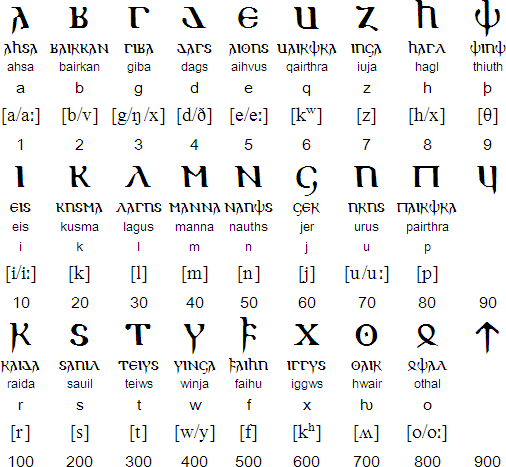
The Gothic alphabet, via omniglot.com
Most of what we know about the Gothic language comes from a few fragments of the Gothic-language Bible, which was first translated under the supervision of a bishop named Ulfilas. (Incidentally, most of these these precious codices are 6th century copies of older manuscripts that have not survived.) Ulfilas (Wulfila in Gothic) was the son of Christian Greeks captured by Goths. He was, thus, raised with a foot in two worlds. He eventually became a priest and a missionary among the Goths, converting many of them to Christianity in the 4th century. As part of his work, Ulfilas decided to translate the Greek bible into Gothic, but first, he needed to devise a Gothic alphabet. His letters seem to draw on Greek, Latin, and Runic influences.
Sometime around the year 600, a Gepid mercenary committed murder . His victim was a bodyguard of the Emperor Maurice who had been taking part in an impromptu deer hunt. When the bodyguard became separated from the other hunters, the Gepid fell upon him and threw his body into a nearby ravine. The motive: greed. From his victim, the Gepid took a precious golden belt.
From the collection of the Metropolitan Museum: “This incomplete, massive gold girdle composed of a series of solidi (gold coins) and medallions may have been worn as an insignia of office. The four medallions depicting the emperor Maurice Tiberius (r. 582–602) probably were minted for him to present as gifts to high officials and nobles when he assumed the office of consul in 583.”Continue reading →





 A Queen's Cup