The Gepid kingdom ultimately succumbed to an alliance between the Lombards and the Avars. The Avars were relative newcomers on the eastern European scene. Their origins have long been shrouded in mystery, but the prevailing theory proposes that they were refugees from the Rouran Empire of the Mongolian steppe, which had been overthrown by the Göktürks. For over a thousand years, their true origins were a mystery waiting to be solved.
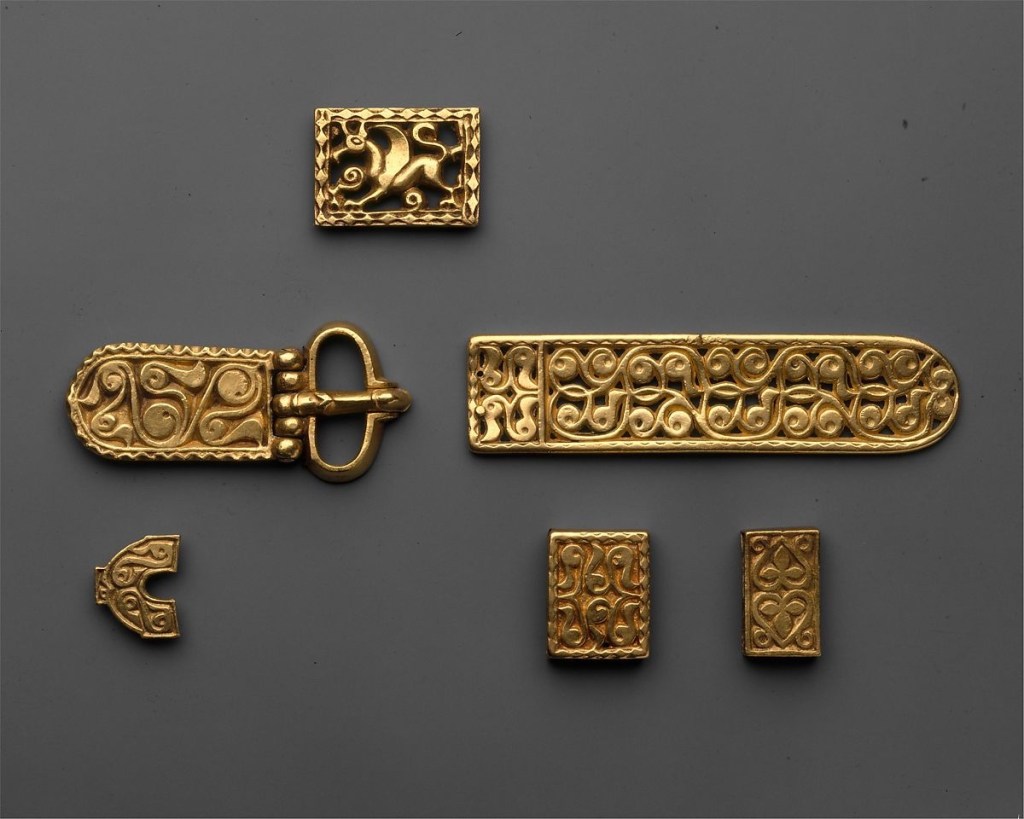
8th century Avar belt fittings, including a belt mount with the figure of a winged horse or griffin. Image via the Met Museum.
As I prepared to write Rosamund’s story, one of my first tasks was to place her in a political and geographical context.
A topographical view of the relevant region. The sickle-shape of the rugged Carpathians served as a natural bulwark for peoples settled on the Great Hungarian Plain (also known as the Pannonian Basin/Carpathian Basin). Strategic earthworks constructed by the Romans in the 4th century may have provided an additional, man-made line of defense.
When the Gepids first appear in the historical record, they reside along the upper reaches of the Tisza River. This would have been a less than ideal environment, pressed up against the mountains and exposed to peoples funneling off the steppes into the Great Hungarian Plain. The bulk of their population probably remained in this area throughout the period of domination under the Huns. They would have served as a sort of buffer nation. Along with the Goths, they were supposedly the Germanic tribe most favored by Attila. The proximity of their settlement area to nucleus of Attila’s empire on the Hungarian plain probably reflects this preferred status.

 A Queen's Cup