As I prepared to write Rosamund’s story, one of my first tasks was to place her in a political and geographical context.
A topographical view of the relevant region. The sickle-shape of the rugged Carpathians served as a natural bulwark for peoples settled on the Great Hungarian Plain (also known as the Pannonian Basin/Carpathian Basin). Strategic earthworks constructed by the Romans in the 4th century may have provided an additional, man-made line of defense.
When the Gepids first appear in the historical record, they reside along the upper reaches of the Tisza River. This would have been a less than ideal environment, pressed up against the mountains and exposed to peoples funneling off the steppes into the Great Hungarian Plain. The bulk of their population probably remained in this area throughout the period of domination under the Huns. They would have served as a sort of buffer nation. Along with the Goths, they were supposedly the Germanic tribe most favored by Attila. The proximity of their settlement area to nucleus of Attila’s empire on the Hungarian plain probably reflects this preferred status.
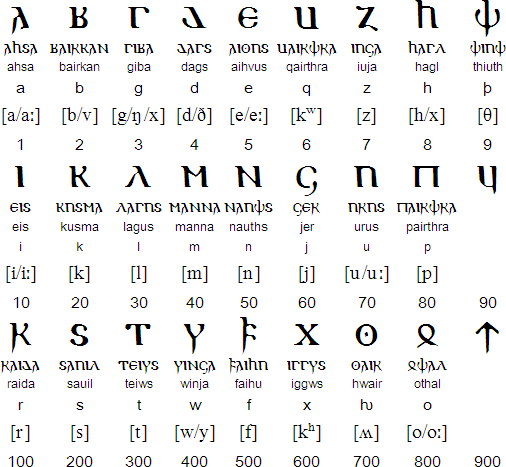
What language did the Gepids speak? They left no written traces that would provide an answer to this simple question. It is possible they spoke a Gothic dialect, but if so, how similar was their spoken language to the what we know of Gothic based on limited written survivals?
The Gothic alphabet, via omniglot.com
Most of what we know about the Gothic language comes from a few fragments of the Gothic-language Bible, which was first translated under the supervision of a bishop named Ulfilas. (Incidentally, most of these these precious codices are 6th century copies of older manuscripts that have not survived.) Ulfilas (Wulfila in Gothic) was the son of Christian Greeks captured by Goths. He was, thus, raised with a foot in two worlds. He eventually became a priest and a missionary among the Goths, converting many of them to Christianity in the 4th century. As part of his work, Ulfilas decided to translate the Greek bible into Gothic, but first, he needed to devise a Gothic alphabet. His letters seem to draw on Greek, Latin, and Runic influences.
Sometime around the year 600, a Gepid mercenary committed murder . His victim was a bodyguard of the Emperor Maurice who had been taking part in an impromptu deer hunt. When the bodyguard became separated from the other hunters, the Gepid fell upon him and threw his body into a nearby ravine. The motive: greed. From his victim, the Gepid took a precious golden belt.
From the collection of the Metropolitan Museum: “This incomplete, massive gold girdle composed of a series of solidi (gold coins) and medallions may have been worn as an insignia of office. The four medallions depicting the emperor Maurice Tiberius (r. 582–602) probably were minted for him to present as gifts to high officials and nobles when he assumed the office of consul in 583.”Continue reading →
In this battle Alboin killed Cunimund, and made out of his head, which he carried off, a drinking goblet. This kind of a goblet is called among them “scala,” but in the Latin language “patera.”
Paul the Deacon, History of the Lombards, Book I, Chapter XXVII
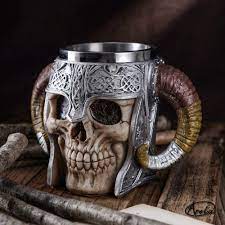
The most infamous cup in Rosamund’s tale is surely the one fashioned from her father’s skull. When I first read about it, I definitely imagined something (for lack of a better word…) goth–appropriate for what I took to be a particularly macabre trophy.
Wicked goth…For some reason, I felt like teeth should definitely be involved!
But upon further research, I realized my initial impressions were probably pretty far off-base–both in terms of the cup’s likely form and its significance.
Rosamund would have presumably spent some amount of time in Sirmium (now Sremska Mitrovika, Serbia), which was under Gepid control in the mid-6th century. This city on the banks of the Sava was once the capital of the Roman province of Pannonia Inferior and, in the 3rd-century, served as a capital of the empire. It boasted forums, basilicas, enormous baths, an aqueduct, a hippodrome, an imperial palace complex, a fortified circuit wall, an extramural necropolis, and numerous urban villas, to say nothing of its more workaday businesses, marketplaces, and habitations. In its heyday, it would have looked something like this…
A model from the museum in Sremska Mitrovika
There aren’t many novels set in this part of the world in the 5th and 6th centuries (at least in English), but those that I’ve been able to find seem to treat Sirmium as a bastion of Roman society, its glory tarnished by the travails of history but still largely intact. My research suggests this was far from the case.
As is probably apparent by the working title of my manuscript, cups play a central role in Rosamund’s story. Obviously the first cup that comes to mind–and the most infamous–is the one made from her father’s skull which ignites her eventual vengeance. But cups, the liquor they held, and the words spoken over them may have had a special significance in Rosamund’s culture.
When writing about Rosamund’s people, I faced a threshold question–what should they be called? Today, they are commonly known in English as the Gepids, but their ethnonym has come down to us in many forms. Greek and Latin sources name them Ghpaides, Gibidi, Gibites, Gepidae, Gebidae, Gebodi, etc. The Origo Gentis Langobardorum refers to them variously as Gyppidos and Gibidos. In the Old English poem Widsið, they are the Gefðum; in Beowulf, they are the Gifðum (both names in the dat. pl.)
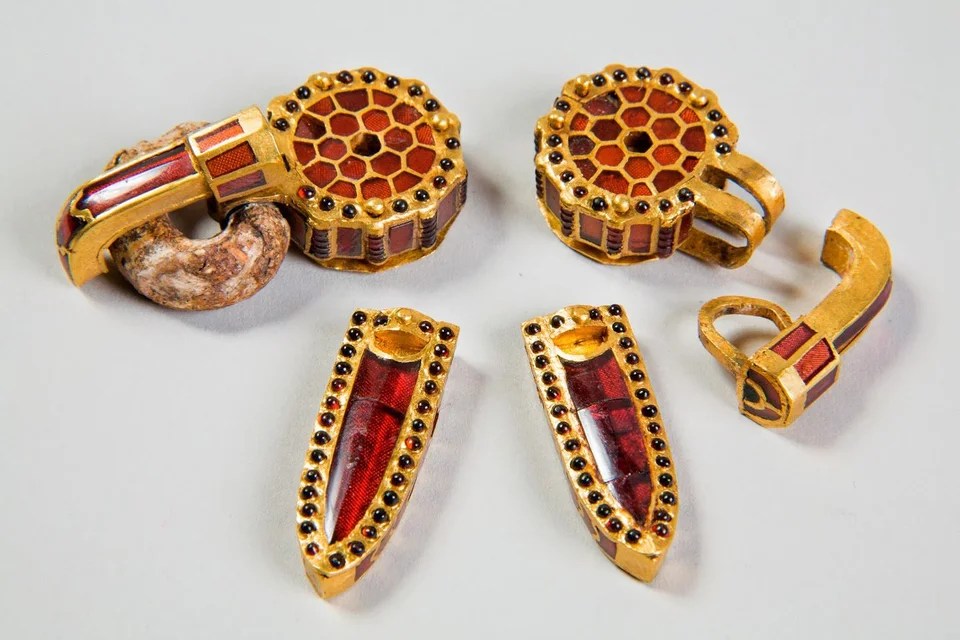
5th century Gepidic buckles and belt fittings from the Treasure of Apahida (via the National Museum of Romanian History)
Taken together, these variations do offer certain clues as to the Gepids’ true name. It seems safe to say that it began with a voiced velar plosive (-g-) sound, with the second consonant being a bilabial plosive (-b- or -p-). B and P seem relatively fluid in names from this period (this is likely due to phonetic shifts underway at the time). For example, the Thuringian king Bisin is named as Pisin in some sources. But even if we can guess what their name sounded like, what did it mean?
Feeling cooped up? Missing international travel or the opportunity to visit first-class museums in new and interesting cities? Here’s something the perk up the pandemic winter doldrums!
The Hungarian National Museum is running a wonderful virtual exhibit featuring some of the most spectacular items from their early medieval collection. It is called “A Country for Women?” The exhibit explores the lives of women in the Carpathian basin–from the Hunnic period in the 5th century through the Hungarian conquest in the 10th century–as discerned through the remnants of their material culture. This includes the period of Lombard and Gepid occupation in the 6th century. Some of these object are quite well known, but the photographs taken for the exhibit cast them in a beautiful light. You can really see every detail in high-resolution splendor!
The name Rosamund remains in current usage, though my impression is that it was more popular in the past. It evokes the Latin phrase rosa mundi (“rose of the world”). In the Greco-Roman world, the rose was a significant flower. It was said to have been created when the goddess of love pricked herself on thorns while rushing to her lover–the flower’s blush evoked divine bloodshed and lust. During the dies rosationis, Romans honored the dead by placing roses on the graves of their ancestors, and various rose festivals were held during the blooming season. Roses were dichotomous symbols representing both beauty and blood, pleasure and death, remembrance and rebirth.
The symbolism of the rose took on new valences with the advent of Christianity. Coelius Sedelius, a Christian poet writing in Latin in the 5th century, used the rose to draw a metaphoric parallel between Eve and the Virgin Mary. Already in the 3rd century, Saint Ambrose postulated that roses only acquired thorns after Adam and Eve’s expulsion from Eden, the thorn itself a manifestation of Eve’s original sin. Coelius Sedelius built on this metaphor, depicting Mary as “the rose without thorn” since she was born through immaculate conception, without the stain of original sin. She became the rosa munda–the “pure rose.”
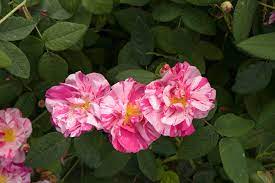
Rosa mundi, an heirloom variety of rose with a dramatic look and romantic folk history
Rosamund’s name, however, is unlikely to take its meaning from either the Latin or Marian rosa. Rather, it probably bears some connection to the reconstructed Proto-Germanic word for “horse”–hrussą. This word filtered into many later languages. In Old English, a horse was hors, in Old Saxon hros, and in Old High German ros. A cognate for “horse” in Gothic/Gepidic could explain the first element in Rosamund’s name. There’s just one small problem.
Very early on in my outlining, I realized that I would have to play around with the historic timeline in order to tell Rosamund’s story to best effect.
The showdown between the Gepids and the Lombards unfolded in two main phases–549-551 and 565-567. In the conventional telling of Rosamund’s life, the first phase concludes with a Lombard victory at the Battle of the Asfeld in which her uncle, the heir to the Gepid throne, is killed by Alboin himself. Thereafter, a truce is declared. But while the Gepids are still in mourning, Alboin presents himself at their door for a ceremonial handover of the slain prince’s weapons. By most accounts, this was Rosamund and Alboin’s first meeting–a dramatic and emotional encounter, no doubt!





 A Queen's Cup