Coins of the Gepids

Cunimund (and possibly Thurisind) supposedly minted silver coins (half-siliqua, quarter-siliqua) in the style of Roman currency in Sirmium. The Ostrogoths first restarted the Roman mint in Sirmium when they occupied the city between about 505 and 535. Coins from the period of Ostrogothic occupation commonly bear the names of the then-ruling Roman emperor on the obverse, and the monogram of Theoderic, the Ostrogothic king, on the reverse. They definitely struck coins in the name of Anastasius (491-518) and Justin I (518-527), and it is possible they minted coins during the first years of Justinian’s rule beginning in 527.

Despite the caption, this was almost certainly an Ostrogothic coin; note the name of Emperor Anastasius on the obverse and the monogram of Theoderic on the reverse. The inscription on reverse reads INVICTA ROMA (“invincible Rome”)

It appears minting operations ceased for a time during the transition from Ostrogothic to Gepidic control of the city, about 527-535. The exact date of the Gepid takeover is not definitively known, but the earliest possible date for resumption of minting activity would be around 536. Either Thurisind or Cunimund may have struck coins in the name of Justinian, and Cunimund may have struck coins in the name of Justin II (565-576) for a brief time before the destruction of the Gepid state in 567.

Continue reading
The Gepid State, Part 3–The Queen

A final figure of note must be the queen. Fundamentally, a queen was simply the wife of a king. She need not be his only official sexual partner. Kings of the early medieval period sometimes kept recognized concubines. Some even had multiple wives. Regardless of personal arrangements, the queen took precedence over the other women in the king’s orbit.

In the 6th century, the position of queen was essentially personal. She was not anointed in a special ceremony that we know of. A woman became queen when she married a king–provided that was her husband’s will. But marriage itself was less “hard and fast” in those days. In a Christian context, marriage was not a sacrament, and divorce was no taboo in the “barbarian” traditions. The position of queen was, therefore, inherently precarious.

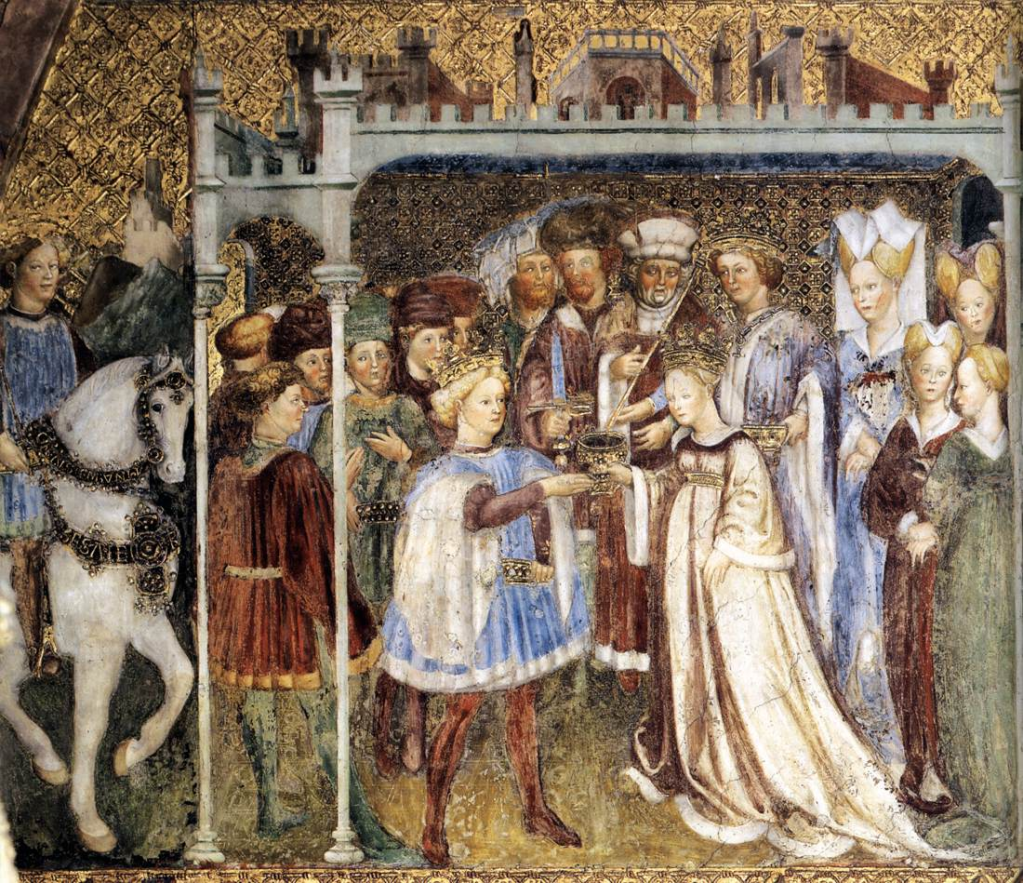
In a chapel in Monza Cathedral, frescoes depict the life of Lombard Queen Theodelinda. In this scene, Theodelinda meets her royal husband-to-be and, significantly, offers him refreshment. Zavattari & sons, 1444.
Continue reading

This Means War

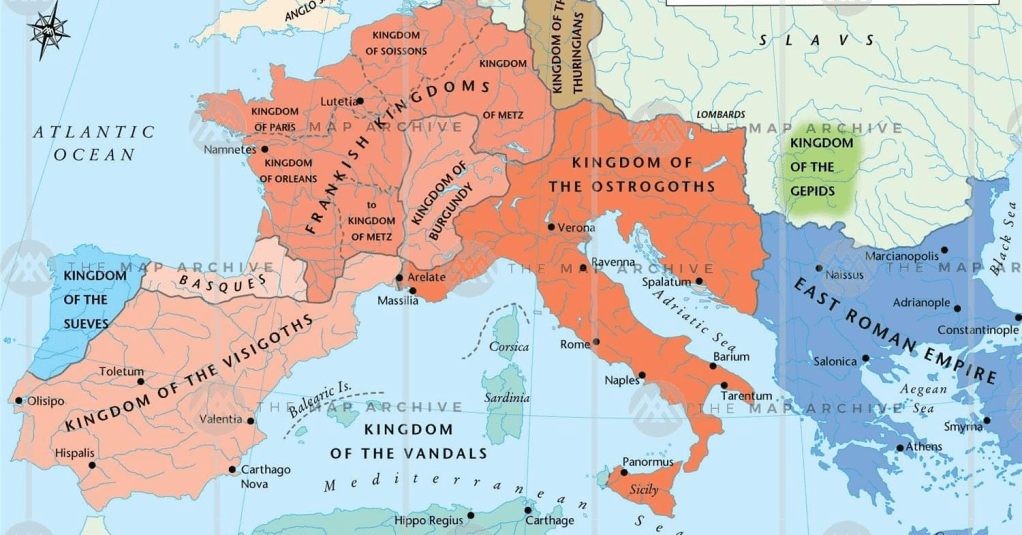
The Gepid kingdom ultimately succumbed to an alliance between the Lombards and the Avars. The Avars were relative newcomers on the eastern European scene. Their origins have long been shrouded in mystery, but the prevailing theory proposes that they were refugees from the Rouran Empire of the Mongolian steppe, which had been overthrown by the Göktürks. For over a thousand years, their true origins were a mystery waiting to be solved.

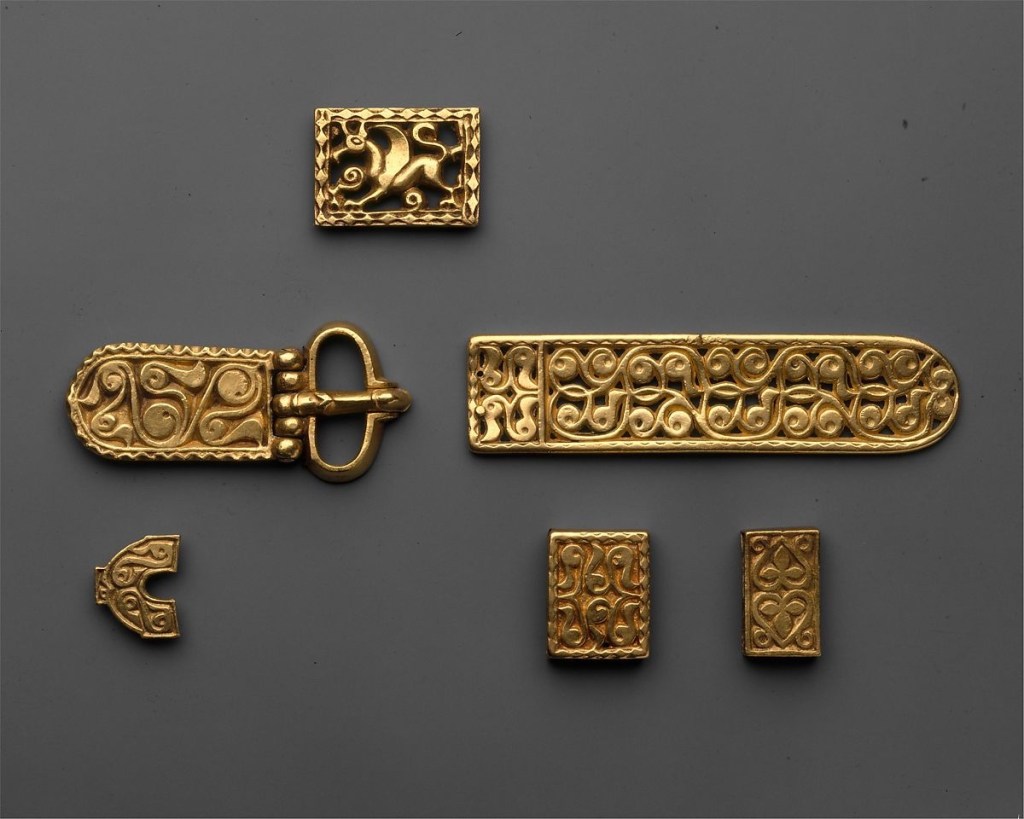
8th century Avar belt fittings, including a belt mount with the figure of a winged horse or griffin. Image via the Met Museum.
Continue reading

Women’s Traces, Part 2: The missing mother

While we know that Rosamund was supposedly the daughter of Cunimund, last king of the Gepids, her mother is never named in the sources. Her absence leaves an intriguing opening in the story, which I’ve seen fit to fill.

I’ve invented a highly speculative backstory for Rosamund’s mother by weaving together a number of historical threads. First, I had to decide on her “ethnicity.” Rosamund’s parents would have married sometime in the 540s, around the time when Cunimund’s father–Thurisind–became king. Thurisind usurped the Gepid throne from the previous king’s son. Thus, his kingship–and his new dynasty–may have been on somewhat shaky ground. For that reason, I suspect that Cunimund’s marriage would have had a political implications. Most logically, the union would have either (1) sealed an alliance with a powerful Gepid clan, thus shoring up internal support for the new regime OR (2) secured a useful alliance with an external group that could under-gird the new dynasty’s power and legitimacy. Since we know next to nothing about the internal politics of the Gepids, I decided to construct a heritage for Rosamund’s mother outside the Gepid gens.

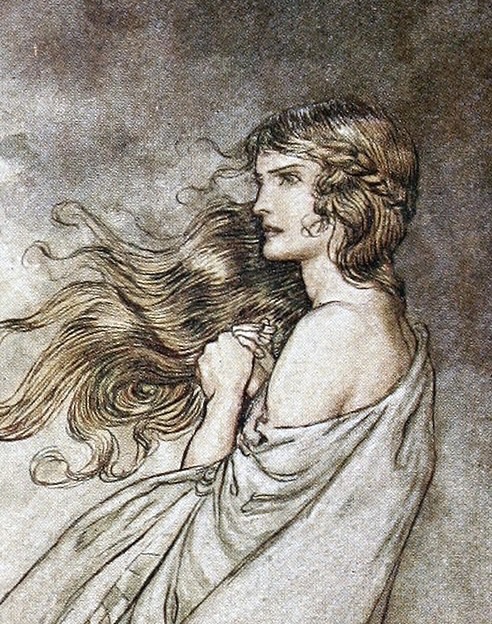
Image taken from Arthur Rackham’s gorgeous illustrations of the Ring Cycle. This is his Brunhilde, a fierce heroine of Germanic legend, possible inspired by an actual 6th century queen of the same name.
Continue reading

The Gepid State, Part 2–Searching for the Invisible

It’s hard to overstate how many hours I’ve lost to contemplation of Gepid political organization. Yet even after all this time (and all that I’ve written,) it remains illusive. The facts simply do not survive. I’m left with my own speculation built on whatever comparisons seem appropriate.

So which comparisons are fruitful to explore? Even that is up for debate. Obviously, there’s some attraction to considering Ostrogothic and Visigothic political organization, especially since I’ve decided to treat the Gepids as a “Gothic” tribe. And conveniently, the documentation for both these kingdoms is relatively robust. Among other sources, Euric’s Code gives insight into the Visigoths in the late 5th century while Cassiodorus’s Variae does likewise for early 6th century Ostrogothic Italy.

So why not simply import these military, civil, and court structures and call it a day?

Continue reading

The Three Wives of Wacho

Early on in my research, I spent a lot of time just trying to wrap my arms around names and dates. I created my own timelines of Lombard and Gepid history and learned all that I could about the protagonists. One of these was Wacho, King of the Lombards from ~510-540. Wacho (whose actual name may have been something more like “Waldchis,”) was a member of the noble Lething dynasty. He came to power by killing his uncle, King Tato, and various rival kinsmen. Despite the rocky start, he proved a capable king, and much of his success was based on the strategic marital alliances he arranged both for himself and his children.

According to the Lombard chronicles, Wacho married three times. His first wife was Raicunda, a Thuringian princess. This marriage was apparently without surviving issue. His second marriage was to a Gepid princess, Ostrogotho (“Austrigusa” in Lombardic,) which produced two daughters, Wisigarda and Waldrada. Both girls would eventually marry Merovingian royalty. Finally, he married Silinga, the daughter of the Herul king Rodulf, who was defeated by the Lombards under their former king, Tato. Silinga gave Wacho his son and heir, Waldari.

But as I mulled over this account of Wacho, his wives, and their children, a few details kept bothering me.

Continue reading

Who were the Gepids, Really? New Clues!

Paleogenetics–the collection, analysis, and interpretation of ancient DNA–sheds new light on the movement and interaction of human populations. The bodies of the dead can sometimes speak, even when their graves are disturbed and the historical record is silent. So I was extremely interested to read a recent paper, Maternal Lineages of Gepids from Transylvania by Alexandra Gîngută, et als., published in the journal Genes.

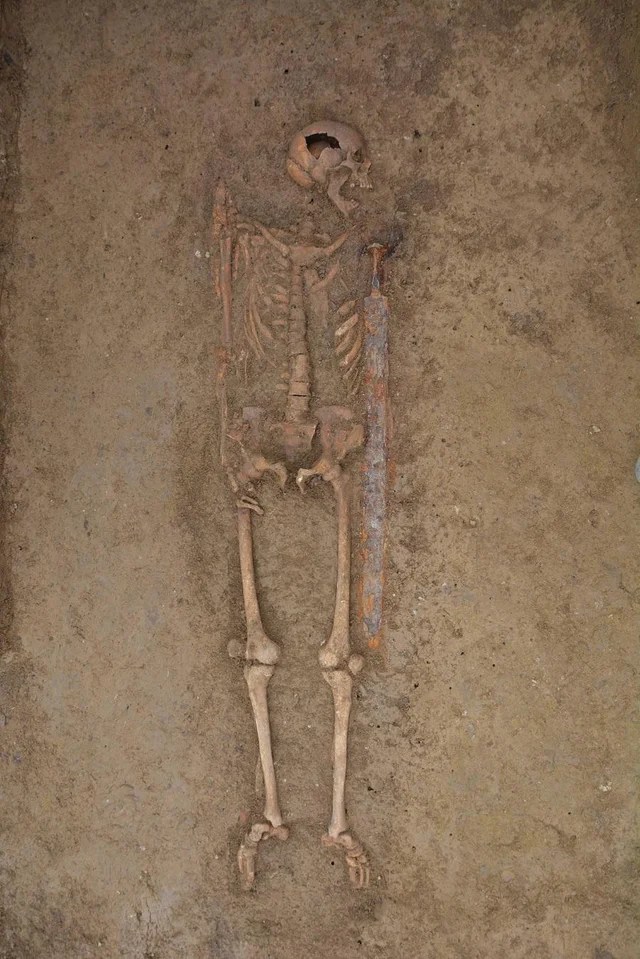
Grave a Gepid man, discovered in Serbia in 2019. Photo via National Geographic Srbija (https://nationalgeographic.rs/priroda/zemlja/a24230/veliko-otkrice-u-viminacijumu-pronadjen-grob-pripadnika-gepida-foto.html)
Continue reading

Women’s traces, Part 1: Alboin’s Sister

Widsið maðolade, wordhord onleac,
se þe monna mæst mægþa ofer eorþan,
folca geondferde; oft he on flette geþah
mynelicne maþþum. Him from Myrgingum
æþele onwocon. He mid Ealhhilde,
fælre freoþuwebban, forman siþe
Hreðcyninges ham gesohte
eastan of Ongle, Eormanrices,
wraþes wærlogan. Ongon þa worn sprecan
Widsith spoke, unlocked his word-hoard,
he who had traveled most of all men
through tribes and nations across the earth.
Often he had gained great treasure in hall.
He belonged by birth to the Myrging tribe.
Along with Ealhild, the kind peace-weaver,
for the first time, east of the Angle,
he sought the home of Eormanric,
king of the Ostrogoths, hostile to traitors.
He began then to speak at length:
….
Swylce ic wæs on Eatule mid ælfwine,
se hæfde moncynnes, mine gefræge,
leohteste hond lofes to wyrcenne,
heortan unhneaweste hringa gedales, beorhtra beaga, bearn Eadwines.


I was in Italy with Aelfwine too:
of all men he had, as I have heard, the readiest hand to do brave deeds,
the most generous heart in giving out rings
and shining torcs, Eadwine’s son.
     
….  
Ond me þa Ealhhild oþerne forgeaf,
dryhtcwen duguþe, dohtor Eadwines.
Hyre lof lengde geond londa fela,
þonne ic be songe secgan sceolde
hwær ic under swegle selast wisse
goldhrodene cwen giefe bryttian.  

And then Ealhhild, Eadwine’s daughter,
noble queen of the household, gave me another;
her fame extended through many lands
when I used my song to spread the word
of where under the heavens I knew a queen,
adorned with gold, most generous of all.
Widsith, ln. 1-9, 71-75, & 97-102 (Transl. soton.ac.uk/~enm/widsith.htm

The preferred histriographic term for Rosamund’s era is “late antique” or “early medieval.” The old descriptor–“the Dark Ages”–with its ominous insinuation of ignorance, brutality, and decline, has fallen out of favor. And yet, this term persists in the popular imagination.

But if the 6th century of Rosamund and Alboin is dark, that is mostly down to our ignorance, not theirs. Very few primary sources from the early middle ages survive. There are many things we simply do not–and cannot–know . But this profound obscurity makes the sources we do have all the more precious and intriguing.

Continue reading

The cup(s) in question–Part 3

The traditional version of Rosamund’s story is quite straightforward: the proud princess, the tragic fall, revenge, betrayal, death. Although it makes for an exciting story, it all strikes me as a little too neat.

I believe there is another story hidden between the lines of the legend, one that sheds light on the politics and culture of Rosamund’s time. Obviously, this is deeply speculative on my part. But it’s also the aspect of Rosamund’s tale that I find most intriguing. Songs and poems and plays have presented the “Tragedy of Alboin and Rosamund.” I want a glimpse of the gritty, foreign reality lurking behind the legend.

This requires analysis, not only of Rosamund’s experience, but that of her contemporaries. I believe that close examination can reveal elements of their reality that would otherwise remain obscure.

Continue reading

The Gepid State, Part 1–Models of kingship

Nothing has caused me more of a headache than trying to imagine the political organization of the Gepids. Very little is known about it, aside from a few stray comments in various sources. We know that they had a king, and at various times there may have been more than one. There was, apparently, some sort of a council of nobles or tribal chiefs that had influence over certain military and political decisions. Beyond that, little can be known for certain.

Frankish King Clovis I (~466-511) dictates to a scribe, attended by his retainers and a rather unfriendly hound. Facsimile of an illumination from the 14th century Grandes Chroniques de Saint-Denis.

Other “states” (loosely defined!) of the time are somewhat less mysterious. We have a sense of the complex court and political offices of the Eastern Empire. Among the “barbarians,” the Merovingian court is relatively well documented, but due to the particular circumstances in Frankish kingdom, this many not shed much light on the organization of the Gepids around the same time. The Franks, after all, incorporated a Gallo-Roman elite and Catholic ecclesiastics into their administrative state. I’ve seen no evidence that these factors were present to a significant degree in “Gepidia.” Indeed, for a time the Gepids may have engaged in a project of constituting themselves as a political and ethnic body precisely in contrast to Roman precedent.

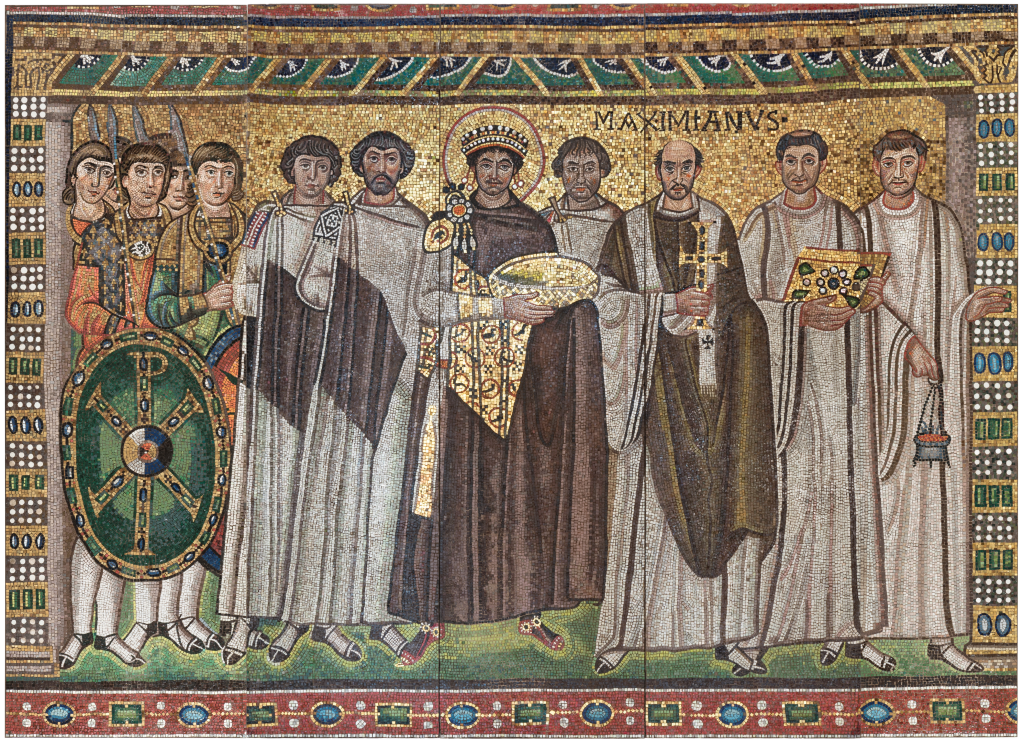
The Eastern Roman Emperor Justinian, flanked by members of the imperial court. We see religious officers, aristocrats, and armed retainers. 6th Century mosaic from the Basilica of San Vitale in Ravenna.

Yet surely there was a Gepidic court. Even Attila had secretaries, after all.

Continue reading