As anyone who’s read this blog can attest, I like history, even the dry, complicated bits. Maybe especially the complicated bits. But even my tolerance has its limit. And that limit is the Controversy of the Three Chapters.
What was the Controversy of the Three Chapters, you may ask? You don’t want to know. Seriously. It’s needlessly complex and boring. One of the greatest descriptions I’ve come across was in Thomas Hodgkin’s magisterial, eight-volume “Italy and Her Invaders,” published in 1896. His work is absolutely out-of-date and in many places inaccurate. Still, Hodgkin writes with inimitable 19th century British flair, his plummy accent practically dripping from the page. To wit:
It is necessary to remind the reluctant reader of that dreary page in ecclesiastical history known as the controversy of the Three Chapters. Most futile and most inept of all the arguments that even ecclesiastics ever wrangled over, that controversy nominally turned on the question whether three Syrian bishops of irreproachable lives, Theodore of Mopsuestia, Theodoret of Cyrrhus, and Ibas of Edessa, were to be stigmatised, a century or more after their deaths, as suffering the punishment of everlasting fire, because the Emperor Justinian, sitting in the library of his palace at the dead of night, and ceaselessly turning over the rolls of the writings of the Fathers, had discovered in the works of these three men the germs of the Nestorian heresy. That was nominally the issue, but as all men knew, something more than this trifling matter was really involved. The writings of these three Syrians had been received without condemnation, if not with actual applause, at the great Council of Chalcedon; and the real question was whether the Eastern Emperors should be allowed to inflict a backhanded blow on the authority of that Council by throwing out the souls of these three hapless Syrians to the Monophysite wolves of Egypt and of Asia, who were for ever howling after the Imperial chariot.
Hodgkin, Italy and Her Invaders, Book V, Chapter 11 (1896)
In brief, there were ongoing debates within the Christian faith over the the precise nature of Christ (this is literally called “Christology”). For example,was Jesus a creation of God the Father, or was he also an eternal being? Was he exclusively divine, or did he have a human element as well? Did Mary give birth to his divine essence or only his human aspect? Disagreements gave rise to various beliefs that fell in and out of favor with church and political authorities. If people were looking for a doctrinal hill to die on, christology offered a whole mountain range.
And unfortunately, one of the keenest christologists in all of christendom was none other than the Eastern Roman emperor himself–Justinian. He wrote treatises on the subject, truly brain-melting stuff. And when the emperor and his religious advisors came down on a issue, they expected his subjects to fall in line. Refusal to conform was an act of religious and political rebellion.
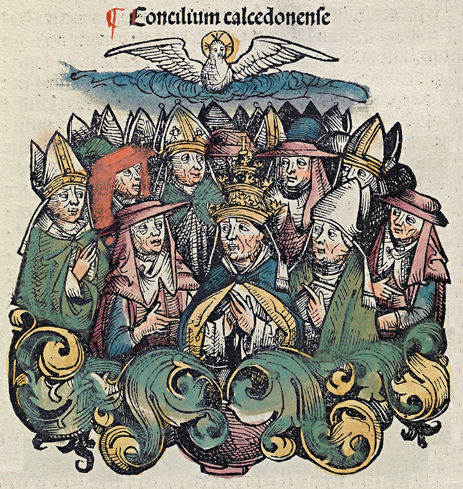
The Three Chapters Controversy involved one such disagreement. The three theological works were initially deemed orthodox, but in 543, at Justinian’s insistence, they were abruptly condemned as heretical. Some quarters objected to the reversal on both doctrinal and political grounds (it seems to me that religion was a fig leaf covering more earthly concerns in many schisms). Many bishops in northern Italy, particularly Venetia and Istria, refused to denounce the “three chapters”.
The debate turned ugly. There was tension and probably sectarian violence. Writings were condemned. Bishops were anathematized. Most of the bishops of Northern Italy were in active conflict with both the pope in Rome and the emperor in Constantinople when the Lombards appeared on their doorstep. Since they were already alienated from their religious and political authorities, these recalcitrant prelates were sometimes able to reach a new and mutually beneficial equilibrium with the Lombards.
So now I face a decision point. Do I include the Three-Chapters Controversy in my story, since it was certainly a political factor in the establishment of the Lombard kingdom? Or do I ignore it as needlessly complicated? The religious basis of the debate is so esoteric as to be virtually meaningless to a modern reader. The political overtones are only slightly more interesting. I’m also already dealing with another religious schism–that between Nicene and Arian Christianity. On the other hand, I’ve striven for historical accuracy and nuance thus far. Glossing over the tricapitoline controversy doesn’t feel right.
But my biggest reservation in wading into the issue is also a selfish one. I have a theory about Rosamund’s conspiracy against Alboin, and it requires that she find allies in the Italian church–allies that are on speaking terms with the Byzantine authorities in Ravenna, not rogue schismatics.
Surely most readers wouldn’t notice the strategic excision of an inconvenient ecclesiastic brawl? Still, I have a sinking feeling I’ll never allow myself to simply wave away the three chapters controversy, but rather find some way to acknowledge its reality without dwelling on its details.
And as for Rosamund’s machinations, I will just have to get a little more creative.
 A Queen's Cup