While we know that Rosamund was supposedly the daughter of Cunimund, last king of the Gepids, her mother is never named in the sources. Her absence leaves an intriguing opening in the story, which I’ve seen fit to fill.
I’ve invented a highly speculative backstory for Rosamund’s mother by weaving together a number of historical threads. First, I had to decide on her “ethnicity.” Rosamund’s parents would have married sometime in the 540s, around the time when Cunimund’s father–Thurisind–became king. Thurisind usurped the Gepid throne from the previous king’s son. Thus, his kingship–and his new dynasty–may have been on somewhat shaky ground. For that reason, I suspect that Cunimund’s marriage would have had a political implications. Most logically, the union would have either (1) sealed an alliance with a powerful Gepid clan, thus shoring up internal support for the new regime OR (2) secured a useful alliance with an external group that could under-gird the new dynasty’s power and legitimacy. Since we know next to nothing about the internal politics of the Gepids, I decided to construct a heritage for Rosamund’s mother outside the Gepid gens.
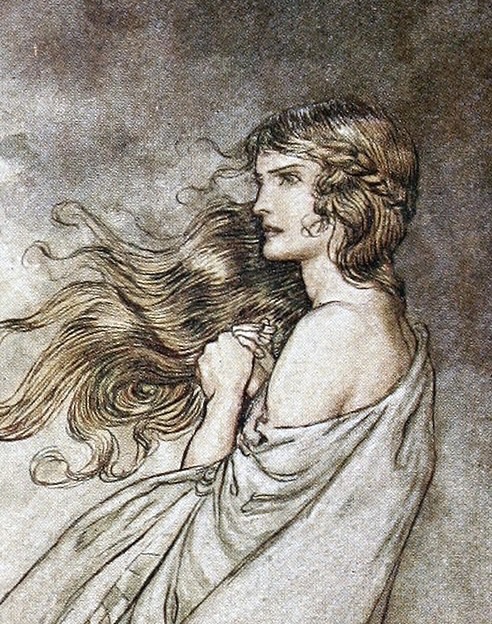
We know from East Roman sources that there was a great deal of drama involving the Romans, Gepids, and a tribe called the Heruls in the mid-540s. The Heruls had been Roman federates for some time, but around 547 a significant number of Heruls rejected their Roman-appointed ruler and defected to the Gepids. They apparently continued as Gepid allies in the following years. The timing of “the Herul affair” presented an intriguing possibility: what if Rosamund’s mother was a Herul whose marriage with Cunimund helped facilitate the political reshuffling? If this were true, Rosamund’s mother would have to be a high-ranking noblewoman, likely a kinswoman of the leaders of the Gepid-allied Heruls. Fortunately, the sources offer some clues in this direction.
But before we get to that, a bit of background on the Heruls is in order. The Heruls (aka Heroli or Eruli) are a fascinating and mysterious group. Traditionally, they’ve been classified as an East Germanic tribe of the migration era, and they are colorfully described in some contemporary sources (Procopius’s Gothic Wars, for example). But they seem to have been a highly mobile and widely dispersed group. Some historians have suggested that they weren’t, properly speaking, a tribe at all. In this hypothesis the Eruli is etymologically related to the Old English eorl, modern English earl, and Scandinavian jarl and meant nothing more than a freelance warrior of noble birth. Either way, there is a consensus in the old sources that at least some of them had ties to Scandinavia.
The Heruls were some of the premier infantry of early medieval Europe. They fought for the Huns, the Romans, the Goths, the Gepids, and the Lombards. They were Odoacer’s key allies during his reign in Italy. They had a reputation for speed and ferocity in battle and were said to be the tallest of the “barbarian” peoples. The sources (many of which, it is worth remembering, had motivation to cast the Heruls in an unflattering light,) paint a portrait of a brutal, warlike culture. Procopius accuses them of human sacrifice and hints at the traditional practice of pederasty and bestiality. Young warriors were sent into battle without a shield to prove their hardiness. Those who survived couldn’t look forward to retirement. If one of them managed to survive to old age (an unlikely event, given their lifestyle), his family would have him killed before ritually cremating him. Herul wives were expected to hang themselves over the graves of their husbands. All in all, a tough crew.
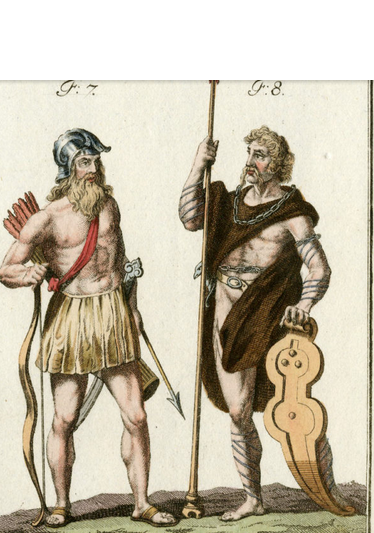
The Heruls formed a short-lived kingdom on the Middle Danube in the late 5th-early 6th century. Their king, Rodulf, was apparently quite renowned. He was an ally and “sword-son” of Theoderic the Great, the Gothic king of Italy (“adoption by arms” was a ritual sometimes used to cement alliances between “Germanic” rulers). In the early 500s, the Lombards moved into the area and were forced to pay tribute to Rodulf. But around 508, the Lombards rose up and dealt the Heruls a crushing defeat. Rodulf himself died in the battle.
The Heruls then split into three parts. Some shifted their allegiance to the Lombards (a process which I’ve discussed elsewhere). Supposedly, archeological traces of them can be detected in Lombard-controlled areas up to the time of the migration into Italy. A second part of the Heruls moved into the Roman sphere of influence and were settled as federates close to modern-day Belgrade. Finally, a third faction left the Danubian region altogether and journeyed north to Scandinavia, where they settled in the vicinity of the Geats (modern Sweden). Supposedly, this was the ancestral home of the Heruls.
Procopius relates the history of the Heruls as we approach Rosamund’s time. Supposedly, the Heruls who lived around Belgrade (then Singidunum) were an unruly and impetuous lot. At some point in the mid-540s, they murdered their petty king, intending to do without a leader. But they soon regretted their decision. Since there was no suitably noble candidate among them to succeed as king, they decided to send envoys to Scandinavia to seek a new king among the old royal family. The Herul embassy slowly made its way north. In Scandinavia, they located a likely man and began the journey back with him, but he died before long. Undeterred, they went back again. This time, the candidate they selected was one Datius, who was accompanied on the journey by his brother, Aordus, and some 200 Herul warriors. Datius and Aordus are quite bizarre names for a pair of “Germanic” princes, but at least we have attestation of their existence and relationship.
In the meantime, the restless Heruls in the south decided they didn’t want to remain kingless any longer. They petitioned the Emperor to supply them with a new leader, and he sent Suartuas, a Herul commander in his service (as I said, the Roman military was chockablock with Heruls). The Heruls gladly acclaimed him king. But shortly thereafter, the embassy to the north returned with Datius and Aordus. The Heruls immediately switched allegiance, and Suartuas barely escaped with his life. Still, the Heruls’ rejection of the emperor’s man soured relations, and about 2/3 of the Heruls (presumably those who preferred Datius and his brother) defected to the nearby Gepids. Thereafter, they were associates of the Gepids, fighting on their behalf and presumably paying them tribute.
This was the local situation around the time Rosamund’s parents would have married. It makes sense to me that a marriage alliance would have accompanied the political realignment. So, in my story, Rosamund’s mother is the niece of Datius and daughter of Aordus. She was born in the north and brings some of the old Herul traditions with her into the marriage. This makes her one tough queen–and an even tougher mother…
 A Queen's Cup
Pingback: Women’s Traces, Part 3: Living Gifts | A Queen's Cup
Pingback: Thurisind or Thaurisinþs? | A Queen's Cup