The traditional version of Rosamund’s story is quite straightforward: the proud princess, the tragic fall, revenge, betrayal, death. Although it makes for an exciting story, it all strikes me as a little too neat.
I believe there is another story hidden between the lines of the legend, one that sheds light on the politics and culture of Rosamund’s time. Obviously, this is deeply speculative on my part. But it’s also the aspect of Rosamund’s tale that I find most intriguing. Songs and poems and plays have presented the “Tragedy of Alboin and Rosamund.” I want a glimpse of the gritty, foreign reality lurking behind the legend.
This requires analysis, not only of Rosamund’s experience, but that of her contemporaries. I believe that close examination can reveal elements of their reality that would otherwise remain obscure.
Rosamund’s marriage to Albion came to a famously bloody end. But marriage between a victorious king and the princess of a defeated people was not without contemporary precedent. The early 6th century Lombard King Wacho married the Herul princess Silinga after her father’s defeat. (I discussed the implications of the union here.) As the daughter of a famous man, Silinga was quite the trophy, and marriage to her would have burnished Wacho’s reputation.
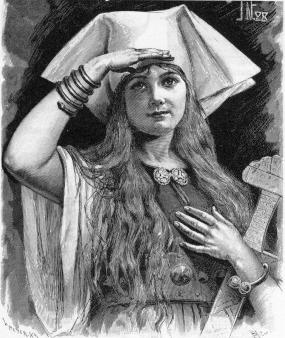
The Heruls persisted under Lombard domination. Many fought for the Lombards in later conflicts, and some even followed Alboin into Italy. It seems highly plausible–if not likely–that Wacho’s marriage to Silinga facilitated the integration of the Heruls. It is impossible to say whether Silinga took an active role in the process. Her presence in Wacho’s court might have been sufficient to placate some of her people. However later examples suggest Silinga may have been an important representative or advocate for the Herul contingent allied with the Lombards. Salinga’s marriage also suggests that it might have been possible for royal authority to pass from a father, through a daughter, to her husband–an inference which is also relevant for the case of Rosamund.
The 6th century Frankish king Chlothar kept multiple Thuringian princesses as wives after he and his kinsmen conquered their kingdom. The most famous was Radegund, later revered for her great piety. But before she ever became a saint, she was war booty. Chlothar and his brothers quarreled over which of them would keep her. Supposedly, Chlothar drew the winning lot.

Although Radegund was a spoil of war, Chlothar’s treatment of her demonstrated her continuing value. Radegund was only a young girl when Thuringia fell to the Franks. Chlothar saw to her maintenance and education until she came of age. He made her a wealthy woman when they finally married–a fortune she would later leverage in her bid to escape him.
Chlothar spent most of his reign trying to outmaneuver and supplant his Merovingian relatives. As his bride, Radegund brought prestige and possibly political connections to the marriage. A foreign bride of royal derivation was an enormous status symbol, and in the 6th century, fame and reputation could bring political advantage. Indeed, Radegund was considered so valuable that Chlothar was very reluctant release her from the marriage when she declared her intention to become a nun.
Additionally, Chlothar’s territorial base was in western Frankia. Radegund’s presence in his court may have served as a political counterweight against his brothers, who lived closer to Thuringia. This would imply that Radegund maintained some influence among the Thuringians, even if it was only bonds of culture or kinship with the surviving nobility.
Radegund wasn’t Chlothar’s only Thuringian bride. He also married her first cousins, the princesses Ingund and Aregund. Chlothar was legendarily lascivious and essentially a polgynist. Despite my best efforts, I’ve found it challenging to pin down the exact dates and sequence of his various wives, consorts, and concubines. By some accounts, he married Ingund before he married Radegund. He later married Ingund’s sister, Aregund. (How and why this happened is an intriguing story for another day.) In any event, Chlothar maintained a connection to the Thuringian royal dynasty until his death in 561. There must have been some political advantage in doing so.
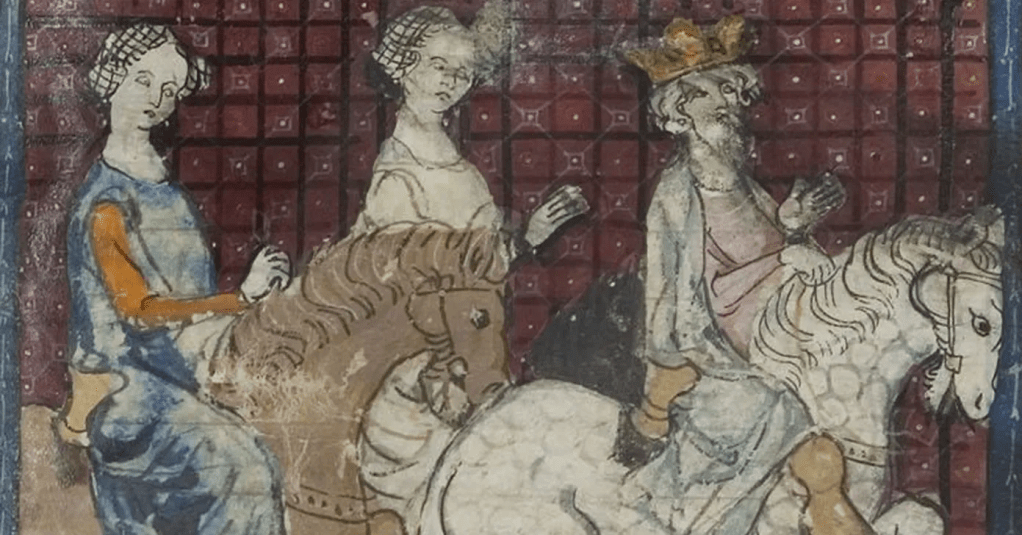
The third noblewoman I’ve considered in relation to Rosamund is the slightly later Lombard queen Theodelinda. She was a Bavarian princess descended from a venerable Lombard dynasty on the maternal side. She married the Lombard king Authari in 588, but he died just a few years later. According to Paul the Deacon, Theodelinda was so respected by the Lombards, they asked her to select her husband’s successor. She supposedly chose Agilulf, the Duke of Turin, whom she then married.

While enticing, I suspect this narrative has been subject to major distortion. It seems unlikely that the Lombards would give a woman (even one with a pedigree as impressive as Theodelinda’s,) much autonomy in selection of their leader. More likely, she served as both a representative of a powerful faction within Authari’s court and an instrument for legitimization for the new king. As a widowed queen, she imparted some portion of the royal majesty to her new spouse. Her own descent from an ancient and royal Lombard dynasty only added to the prestige of the match. Some of the old king’s following (or, indeed, Theodelinda’s own,) probably also transferred their allegiance to Agilulf with the marriage. While this reading of Theodelinda’s second marriage is somewhat less empowering, it’s more interesting from a political perspective. Theodelinda must have been quite the diplomat to navigate the various factions in the Lombard Court while maintaining her own influence–especially since her own fate was bound to the outcome of the negotiations!
The lives of Silinga, Radegund, and Theodelinda all indicate that some degree of royal authority could be attained through marriage with royal women, whether daughters or widows. This was especially the case when the taking of a queen coincided with a political transition, such as the conquest of a people, the ascension of a new king, or the integration of a new group into an existing polity. Salinga facilitated the absorption of her people to the Lombards, just as Rosamund would do a generation later. Radegund (and Ingund/Aregund) enhanced her husband’s authority and influence over a subject people. Theodelinda sealed the legitimacy of a new monarch from a different dynasty.
Finally, we have the life of Rosamund herself, some aspects of which are often overlooked in favor of the more dramatic episodes. Between the time of her capture and her revenge, she was Alboin’s queen. And Radegund’s case demonstrates that a wife acquired by plunder was considered no less legitimate or valuable.
Queens of the time occupied a unique and somewhat isolated position. They were one of very few women active at court. They had privileged access to the king and his ministers and often cultivated relationships with powerful noblemen and clerics (both foreign and domestic). A queen might work to support her husband, but she could also represent other interests–her own, those of her children or kin, even religious interests. Reading between the lines, I believe that Rosamund was the leader of a Gepid faction within Alboin’s court. Indeed, her followers were partly the basis for the attempted coup. She then attempted to legitimize a new king via marriage. Unfortunately for Rosamund, her second husband was not accepted by the Lombards as a whole (another clue that Theodelinda probably remarried with the input and consent of the Lombard nobility).
I previously described the communal drinking practices of Rosamund’s time. Ritual cups served as precious ornaments and potent symbols. In a sense, these queens did likewise. If drinking could bind a king and his followers, marriage could likewise bring a new faction into the fold. The queen herself represented this blending, which ideally manifested in the mingling of noble lineages in her womb–another sort of vessel. From this point of view, it seems only natural that she would have a part to play in the drinking rituals that bound a king and his followers, that she would be the medium and receptacle of their oaths.
I’ve come to believe that the people of Rosamund’s time perceived the world somewhat differently than we do. They were more sensitive to signs and symbols all around them. These weren’t understood merely in metaphorical terms. I believe that, to them, the symbolic world was something much more real and immediate. It shaped their consciousness in ways quite unfamiliar to modern people in the west. I struggle to adequately capture this aspect of Rosamund’s experience in my writing, but I think it’s worth the effort.
The movement of a queen—among peoples, factions, and husbands–obviously carried political and symbolic meaning to those around her (if one can even distinguish the two). These women didn’t just pass the cup; they embodied it. Speculative though this idea may be may be, it is at the heart of A Queen’s Cup.
[I owe a lot of my thinking in this direction to the ideas of Owen Barfield. I would highly recommend his work to anyone interested in learning more about myth, evolution of consciousness, and imaginative perception within a literary framework.]
 A Queen's Cup
Pingback: The Gepid State, Part 3–The Queen | A Queen's Cup
Pingback: Women’s Traces, Part 3: Living Gifts | A Queen's Cup