Nothing has caused me more of a headache than trying to imagine the political organization of the Gepids. Very little is known about it, aside from a few stray comments in various sources. We know that they had a king, and at various times there may have been more than one. There was, apparently, some sort of a council of nobles or tribal chiefs that had influence over certain military and political decisions. Beyond that, little can be known for certain.

Other “states” (loosely defined!) of the time are somewhat less mysterious. We have a sense of the complex court and political offices of the Eastern Empire. Among the “barbarians,” the Merovingian court is relatively well documented, but due to the particular circumstances in Frankish kingdom, this many not shed much light on the organization of the Gepids around the same time. The Franks, after all, incorporated a Gallo-Roman elite and Catholic ecclesiastics into their administrative state. I’ve seen no evidence that these factors were present to a significant degree in “Gepidia.” Indeed, for a time the Gepids may have engaged in a project of constituting themselves as a political and ethnic body precisely in contrast to Roman precedent.
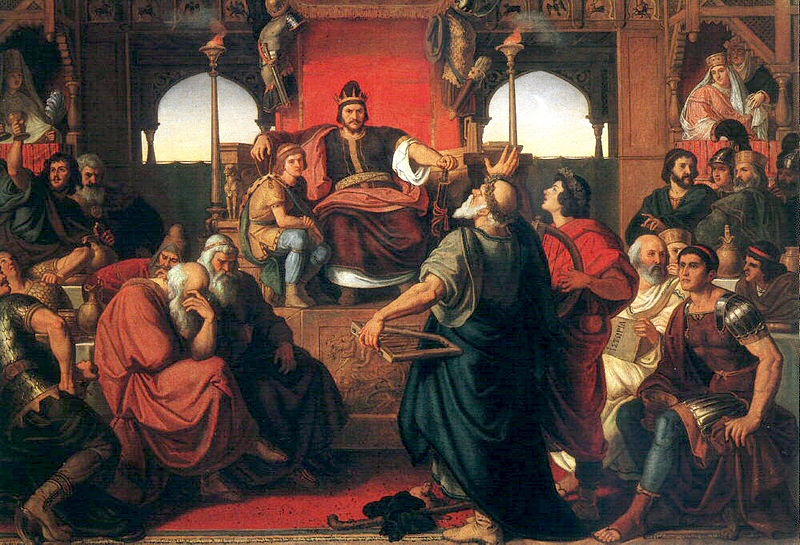
Yet surely there was a Gepidic court. Even Attila had secretaries, after all.
Starting from the top, there was a king. He would have played a leading role in military, legal, and certain religious affairs. The Gepids apparently had some manner of monarchy prior to the arrival of the Huns. We know of a Gepid king Fastida sometime around the 3rd century. Fastida would not have been a king in the classic sense, but rather a leader elected by the army (i.e. all free men under arms) to lead the tribe in times of conflict or migration.
Like other Germanic tribes of the era, Gepid society was probably organized according to class. In the most basic terms, there was an aristocratic class, a free class, an half-free (serf) class, and finally slaves. An elected king would be drawn from the upper echelon of society.
The royal/noble clans traced their lineage to heroes and gods. The king may have been considered semi-divine. He claimed a god-granted right to rule and a sacred charisma that exalted him over enemies and rivals. Eventually, dynasties developed, and power transferred more and more reliably from father to son (or from king to designated heir). Nonetheless, the council of the clans retained its authority and acted as a check on the king’s power.
I find it interesting to contemplate whether exposure to the Huns worked any changes in Gepid political organization. According to Hyun Jun Kim’s The Huns, the Huns practiced a sort of proto-feudalism. The supreme king (Attila) selected men to command military units, most of which were probably organized along tribal lines. These commanders might even have been considered the dukes or sub-kings of their respective fiefs. They were not necessarily noble-born–their authority derived from the king–but many of them were probably high-ranking nobility or relatives of the king. Many of them would have also filled civil/administrative roles. Their lands and authority could be revoked at any time and redistributed. Attila had many wives and children. It is likely that some of his daughters married his vassals to bind them even more closely to the central power of the Hunnic state.
Some archeologists have likewise described 6th century Gepid society as “proto-feudal,” which may speak to a lingering inheritance from the Huns. This characterization is based on the assessment that fully-armed free men constituted a smaller percentage of the Gepid population than in other Germanic tribes. In retrospect, this is conclusion is probably erroneous. Inconsistent/incomplete documentation and extensive grave-robbing have made it very difficult (if not impossible) to definitively characterize the class structure of Gepid society. Most recent reports suggest the class of Gepid free warriors was not significantly smaller than in other tribes of the period.
It is possible, however, that a small elite owned much of the land and livestock which they rented out to tenants, some of whom may have been poor free men, others of whom might have been semi-free serfs. Certainly political power would have been the purview of a small group of royals and high nobles.
In The Huns, Kim also proposes a Hunnic practice of stratified dual-kingship (diarchy). Under such a system, there are two co-kings, often relatives, one of whom is senior to the other. Such a system might have held some appeal to peoples, like the Gepids, that fell within the Hunnic sphere of influence in the 5th century. Many Germanic tribes already had legendary dioscuric ancestor cults and legends (Rao and Rapt among the Vandals, Hengist and Horsa among the Saxons, etc.). They may have been culturally “primed” for dual-kingship. There are tantalizing hints that the Gepids may have practiced some form of diarchy in the late 5th and 6th centuries. In 504, there was one Gepid king based in Sirmium and potentially a second beyond the Tisza. It’s even possible that Thurisind’s son, Thurismod, was not only his son and heir but also his under-king.
Of course, it is also possible that the Gepids had simply fractured into multiple kingdoms in the wake of Hunnic rule. Some academics have suggested as many as 3 Gepid kings in the late-5th to early-6th centuries–one based in Sirmium, one along the Tisza, and one on the Transylvanian plateau. Whatever the case, Gepid power seems to have consolidated in a single dynasty by the time of King Elemund in the 540s.
 A Queen's Cup
Pingback: The Gepid State, Part 2–Searching for the Invisible | A Queen's Cup