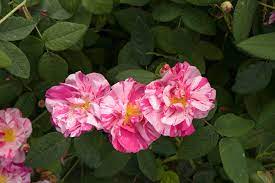
The name Rosamund remains in current usage, though my impression is that it was more popular in the past. It evokes the Latin phrase rosa mundi (“rose of the world”). In the Greco-Roman world, the rose was a significant flower. It was said to have been created when the goddess of love pricked herself on thorns while rushing to her lover–the flower’s blush evoked divine bloodshed and lust. During the dies rosationis, Romans honored the dead by placing roses on the graves of their ancestors, and various rose festivals were held during the blooming season. Roses were dichotomous symbols representing both beauty and blood, pleasure and death, remembrance and rebirth.
The symbolism of the rose took on new valences with the advent of Christianity. Coelius Sedelius, a Christian poet writing in Latin in the 5th century, used the rose to draw a metaphoric parallel between Eve and the Virgin Mary. Already in the 3rd century, Saint Ambrose postulated that roses only acquired thorns after Adam and Eve’s expulsion from Eden, the thorn itself a manifestation of Eve’s original sin. Coelius Sedelius built on this metaphor, depicting Mary as “the rose without thorn” since she was born through immaculate conception, without the stain of original sin. She became the rosa munda–the “pure rose.”
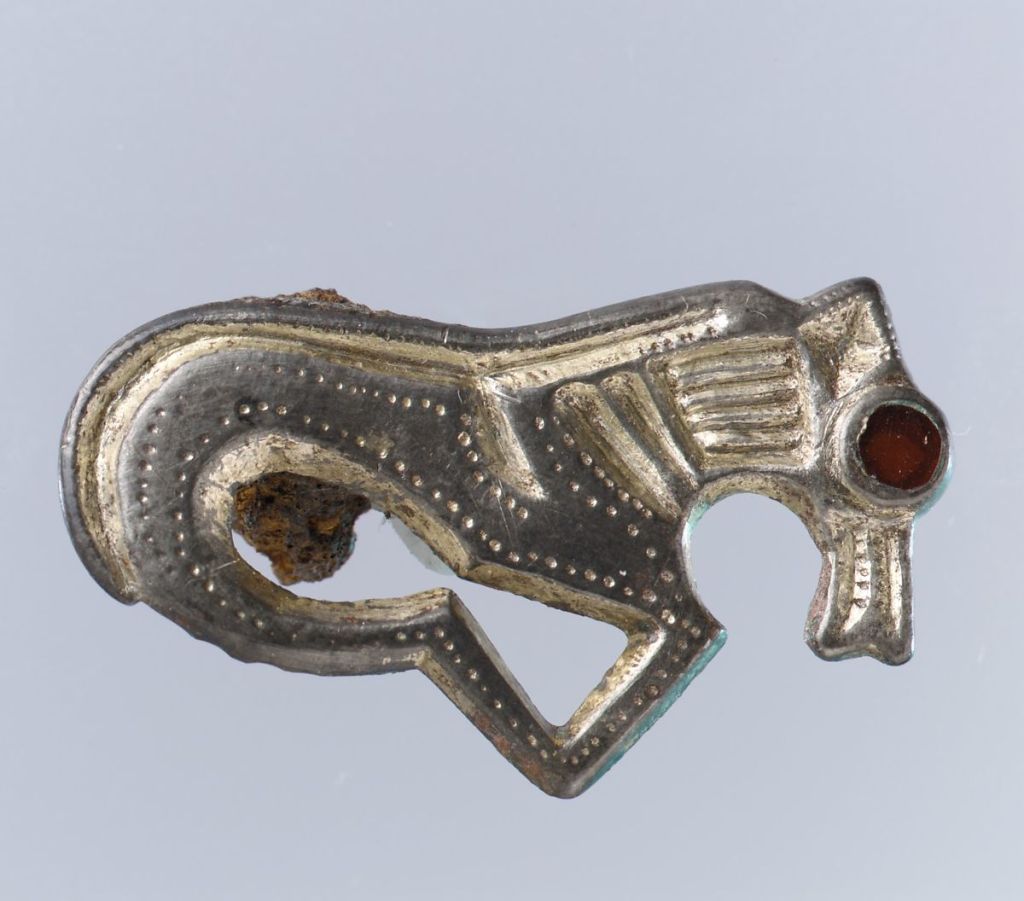
Rosamund’s name, however, is unlikely to take its meaning from either the Latin or Marian rosa. Rather, it probably bears some connection to the reconstructed Proto-Germanic word for “horse”–hrussą. This word filtered into many later languages. In Old English, a horse was hors, in Old Saxon hros, and in Old High German ros. A cognate for “horse” in Gothic/Gepidic could explain the first element in Rosamund’s name. There’s just one small problem.
The reconstructed word for horse in Gothic is aihwas, cognate with the Latin equus. There is no evidence of a Gothic word for “horse” related to the Proto-Germanic hrussą. But could there have been more than one word for the same animal? And if so, why?
It is not so unusual to have multiple words that denote the same animal. A “mare,” “foal,” “nag,” and “charger” are all horses, but each English word conveys additional information with respect to the animal’s sex, age, quality, and training. The horse is a less essential and prestigious animal today than it was in Rosamund’s time. The Gepidic language may have had words for even more types of horses than we do in modern English (domesticated versus wild horses, for example).
Additionally, it was often taboo to speak the “proper” name of a totemic animal. Our word “bear,” for example, derives from a euphemism: “the brown one.” Similarly, Beowulf’s name–which means “bee-wolf”– is a kenning for that same animal; bears notoriously love honey, after all, and prey on beehives like hungry wolves.
It is speculated that the Proto-Germanic hrussą was related to the P-G verb “to run.” In that case, hrussą was likely a euphemistic name meaning “the runner”–an appropriate title for a revered animal. I don’t find it hard to believe that the descendant of such a word could have passed into Gothic/Gepidic.
We are on firmer ground when it comes to the second part of Rosamund’s name. Munda means “protection” in Gothic.
So in my novel, Rosamund’s name means “horse protection.” It makes sense given her cultural context, and I think it suits her personality. I even decided to play up the horse connection by making it the totemic animal of her kin group. As she moves into a more Mediterranean milieu, however, she comes to understand what Latin-speakers hear in her name…and learns how exploit those associations to greatest effect.
 A Queen's Cup