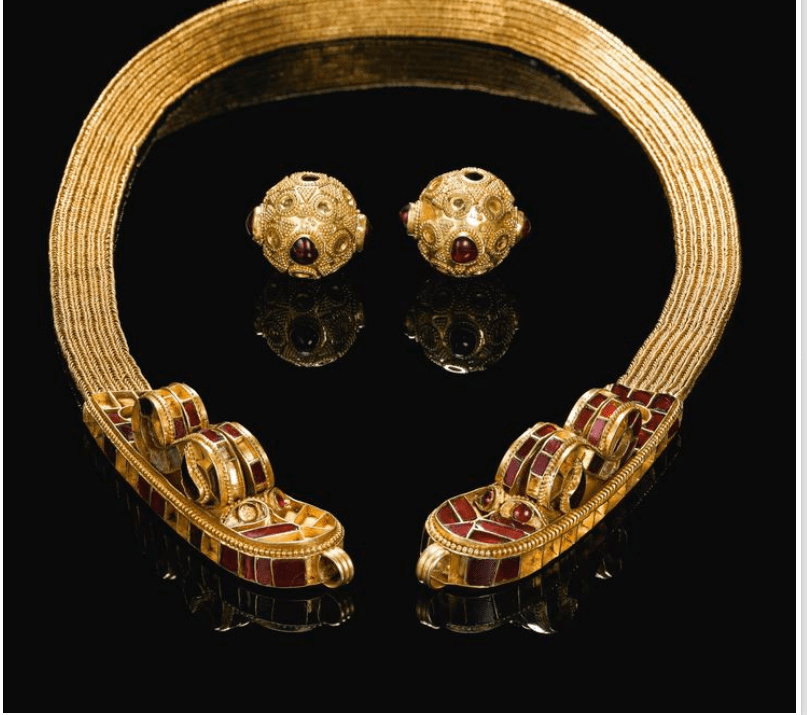
I dwell quite a bit on the material culture of Rosamund’s world. She is deeply attentive to her own attire and that of others and interested in all markers of wealth and status–jewels and ornaments, horses and tack, buildings and decor, food and drink. Although these descriptions will (hopefully!) help a reader to imagine the scene, that is not the primary reason I choose to linger over such details. A person’s clothing and possessions would have “spoken” to Rosamund, communicating their position in the social hierarchy relative to her. In an intensely stratified and relational society, such information was both interesting and essential.

I often think about how many fewer things there would have been in Rosamund’s world compared to ours. As I look around my tiny office, I can see literally dozens of man-made objects, from the paintings on the walls to the rug on the floor, shelves filled with books, tables, chairs, ceramics, carvings, blankets, essential oils, even a bit of precious metal. The sheer number and preciousness of these objects alone would have probably boggled the mind of a 6th century Gepid. Rosamund’s world was one of relative material poverty. But just because there’s less to look at doesn’t mean people look less–they might simply look more closely.
I heard somewhere that there were up to 10 miles of thread in a pair of men’s trousers in the early middle ages. Even if that’s a bit high, it does convey a sense of how much labor went into the production of something as basic as clothing. It’s no wonder that spindle whorls and loom weights are some of the most common artifacts taken out of Gepid settlement areas. Women (and possibly also men) must have been spinning constantly just to keep themselves clothed. They also would have been using mostly plant fiber instead of wool, which adds an extra element of labor to the affair. The flax would have to be planted, tended, harvested, laboriously prepared, and spun before it could finally become cloth.
It’s also important to keep in mind that Rosamund’s understanding of the world and her place in it was shaped by memory and tradition. Her family’s (and her people’s) history was preserved in stories and songs, but were in another sense physically manifest in their royal treasures and heirlooms. Each object contained the memory of where it had come from, to whom it had belonged, and how it came into their possession. Was it loot from a famous battle? A gift from a foreign king? Whatever the case, its presence in the royal residence said something about her family’s wealth and power.
Moreover, objects were, in a spiritual sense, imbued with the power and prestige of those who had once possessed them. This helps explain why Alboin turned Rosamund’s father’s skull into a drinking cup. It wasn’t some macabre whim, but rather a pagan ritual whereby Alboin could imbibe a defeated king’s power and wisdom by drinking from the literal seat of his mind. In this way, even a person could be transformed into a totemic object. It is fascinating to imagine what the Gepids in Alboin’s following would have made of such a display.
 A Queen's Cup